

The Property Collects Rent. What Reaches You?
Expenses, debt, reserves, and distribution terms determine what reaches investors. A practical walkthrough of every layer between a tenant's payment and your cash flow. Understanding each one is not optional. It is underwriting.
Last week, we explained why a functioning apartment can fail its refinance test. This week, we walk through the other side of the same question: when a property does collect rent, what determines how much of that rent reaches the investor? The answer involves four layers. Each one subtracts from the total.
01 — How Much Rent Is Actually Collected?
Vacancy, Concessions, and Bad Debt Sit Between Asking Rent and Revenue
A 100-unit property at 95% occupancy with $1,300 average rent looks like it produces $1,560,000 annually. But several adjustments sit between that number and what the property actually takes in.
-
Five empty units produce zero income. But vacancy also includes units offline for renovation, make-ready periods between tenants, and model units that are never leased.
-
Free months, reduced deposits, and move-in specials reduce effective rent below the asking rate. A $1,300 lease with one month free is actually $1,192 per month over a 12-month term. That difference does not appear in the lease rate. It appears in collections.
-
Not every tenant who signs a lease pays every month. The gap between what is owed and what is collected, typically 2 to 5% in workforce housing, directly reduces revenue.
02 — What Remains After Operating Expenses?
Taxes, Insurance, Maintenance, Management, and Utilities
Operating expenses consume a significant portion of effective gross income before any debt payment is made. In workforce housing, the operating expense ratio typically runs 40 to 55% of effective gross income.
-
Typically the single largest expense line. Varies dramatically by jurisdiction: Texas properties can face effective rates above 2% of assessed value. Some states reassess on sale, creating a step-up that new owners must absorb.
-
Premiums have increased 75% over five years in many Sun Belt markets. Coastal and hurricane-exposed properties face even steeper increases. Insurance is now frequently the second-largest expense line, surpassing maintenance in some portfolios.
-
Routine maintenance, unit turns, landscaping, appliance replacement. Property management at 5 to 8% of EGI. Common-area electricity, water, sewer, on-site staff, legal, marketing, and administrative costs. Workforce housing typically requires higher per-unit maintenance budgets because the building stock is older.
NOI is the number most pitch decks highlight. It is not what the investor receives.
03 — What Remains After Debt and Capital Needs?
73% of NOI Consumed by the Mortgage Alone
Positive operating income does not automatically mean cash is available for distributions. At a 65% LTV on a $10 million property, the loan balance is $6.5 million. At 6.5% on a 30-year amortization, annual debt service is approximately $576,000. That is 73% of NOI consumed by the mortgage alone. Then $48,000 in capital reserves at $480 per unit comes off the top before any distribution.
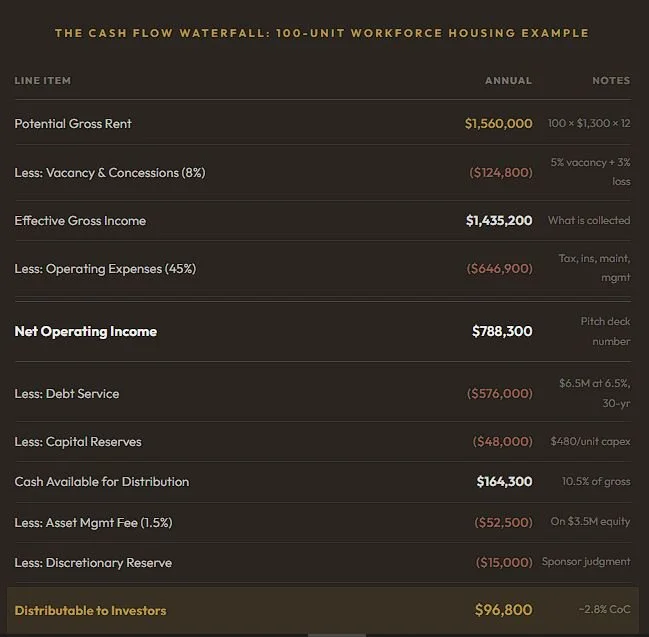
Hypothetical 100-unit workforce housing. $1,300 avg rent. 95% occupancy. 45% expense ratio. 65% LTV at 6.5%. $480/unit reserve.
04 — Who Receives That Cash, and When?
Distribution Terms Determine the Final Answer
The $164,300 available for distribution does not necessarily flow to investors in equal proportion or on a simple schedule. Distribution terms in the operating agreement determine the final answer.
-
Most private real estate investments include a preferred return, typically 6 to 8%, that accrues to limited partners before the general partner participates in distributions. Until the preferred return is met, the GP receives no promote or carried interest from operations.
-
An annual fee, typically 1 to 2% of invested equity or gross asset value, paid to the sponsor for ongoing portfolio oversight. This is deducted from distributable cash.
-
The sponsor may elect to retain additional cash beyond the standard capital reserve. Monthly, quarterly, or annually: the schedule affects when cash reaches investors, not whether it does. But longer intervals mean cash sits in the property account rather than the investor account.
05 — The Downside Question
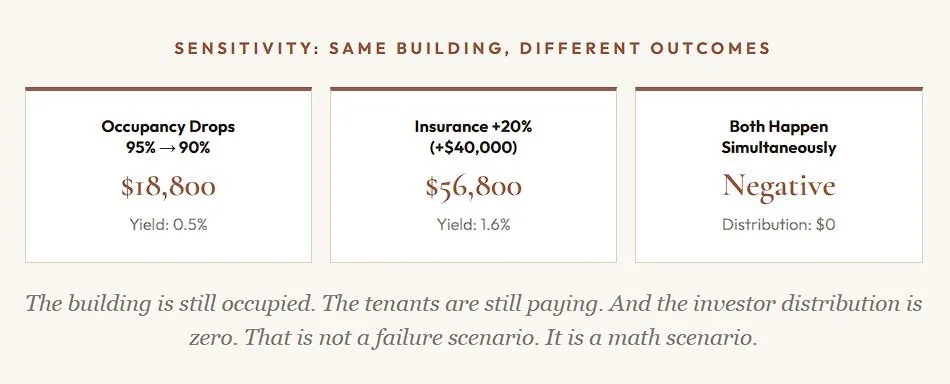
What Happens If Collections Weaken or Expenses Rise?
06 — The Investor Checklist
Six Questions That Separate Projected Returns from Deliverable Cash Flow
-
Not the asking rent. Not the signed lease rate. The cash that physically arrives in the operating account after vacancy, concessions, and delinquency.
-
A 45% ratio and a 55% ratio produce dramatically different NOI from the same top line. Ask which line items have been increasing fastest.
-
NOI divided by annual debt service. Below 1.20x, there is limited cushion. Below 1.00x, operating income does not cover the mortgage.
-
Underfunded reserves mean deferred maintenance, which means either future capital calls or declining property value.
-
Preferred return level, fee structure, reserve policy, and distribution frequency all determine what reaches investors and when.
-
If the loan matures in 3 to 5 years and the property must refinance at a higher rate, does the projected cash flow survive the new debt service?
Closing Perspective
Understanding Each Layer Is Not Optional
“The property collects rent. What reaches you is a different number. Between the tenant’s payment and the investor’s distribution sit vacancy, concessions, debt, reserves, fees, and sponsor discretion. Each layer subtracts. Understanding each one is not optional. It is underwriting.”