

98 Properties. 30 Federal Agencies. 98% Occupied. Someone Just Built a $450 Million Portfolio Around the Most Creditworthy Tenant in America.
In a market where 81% of software loans are being marked down and BDCs are hitting redemption gates, someone raised $450 million for buildings leased to the United States government. That contrast is the entire signal.

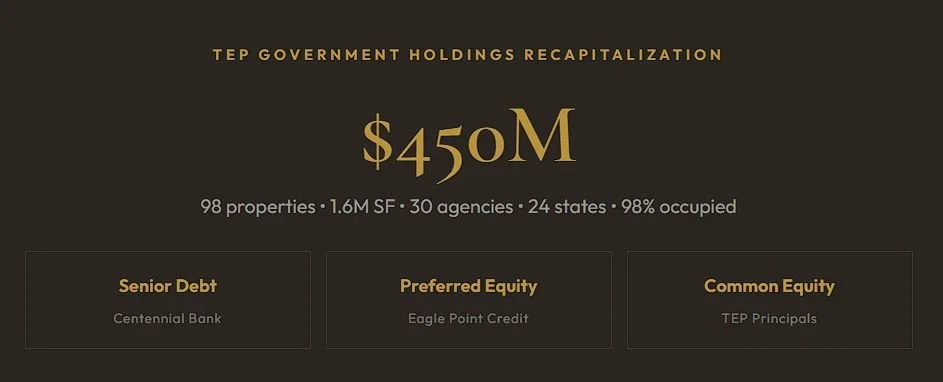
This morning, Tanenbaum Equity Partners announced the recapitalization of TEP Government Holdings: 98 properties, 1.6 million square feet, 24 states, leased primarily to 30 federal government agencies. In a market where software loans are being marked down and BDCs are hitting redemption gates, someone just raised $450 million for buildings leased to the United States government. That contrast is the entire newsletter.
01 — Why This Transaction Matters
Sovereign Credit. Structural Occupancy. Institutional Capital Structure.
-
Federal agencies do not go bankrupt. They do not miss rent because of a bad quarter. They do not renegotiate leases because AI disrupted their revenue model. The General Services Administration manages federal real estate obligations backed by the full faith and credit of the United States. That is the strongest credit in the global economy.
-
98% across 98 properties is not a lucky quarter. It is the mathematical result of a tenant that occupies space because it is legally required to serve the public. Social Security offices, VA facilities, federal courts, and regulatory agencies operate because Congress funds them. The demand does not fluctuate with consumer sentiment.
-
Consolidating 98 property-level financings into a single senior debt plus preferred equity structure reduces refinancing complexity, improves cash flow visibility, and positions the portfolio for growth. This is capital-stack sophistication that separates institutional ownership from fragmented management.
-
This closed in September 2026. The same month that BDC redemption queues are building, software loans are being marked down, and the Fed just hiked rates. Capital that could go anywhere chose government-leased real estate. That is not accidental. It is selective.
02 — The Part Most Headlines Miss
Sovereign Credit Is Real. Political Exposure Is Also Real.
The Risk That Deserves the Same Analytical Discipline
The federal government is the most creditworthy tenant in America. It is also the most politically exposed. DOGE has explicitly targeted federal real estate footprint reduction. GSA has been directed to review space utilization across agencies. Lease consolidation and remote work policies could reduce the number of facilities the government needs over time.
A 5.2-year weighted average remaining lease term means some of these leases will come up for renewal during a period of active federal space rationalization.
TEP has spent a decade building expertise in this exact niche. That specialization is either the moat or the concentration risk depending on how the federal real estate review unfolds. Both reads are defensible. Neither is simple.
03 — Follow the Capital
Where Stress Lives vs. Where Capital Just Deployed
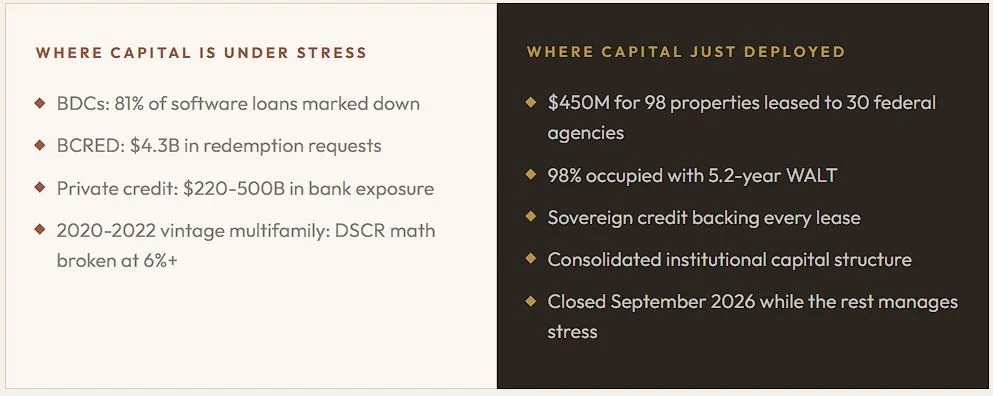
In a cycle where software revenue is being repriced, private credit is hitting redemption gates, and apartment capital structures are failing their refinance tests, someone raised $450 million for buildings leased to the federal government. The income is sovereign. The occupancy is structural. The demand is non-discretionary.
04 — What We Are Watching
Four Variables That Determine What Happens Next
-
GSA and DOGE directives on government real estate footprint. Any reduction in occupied space affects renewal probability for the 30 agencies in this portfolio.
-
With 5.2-year WALT, the first renewals arrive around 2029 to 2031. Whether agencies renew, consolidate, or vacate determines whether the 98% occupancy holds.
-
If capital continues flowing into government-leased real estate, it validates a thesis that sovereign credit plus physical occupancy equals the most defensible net lease segment in the market.
-
If government tenants command a meaningful cap rate premium over corporate tenants, it tells you the market is pricing creditworthiness over yield.
05 — The IGC Takeaway
Two Forms of Non-Discretionary Demand
At IGC, we apply the same principle to a different tenant. Workforce housing is not backed by sovereign credit. It is backed by something equally non-discretionary: the structural requirement that 11 million households have for a place to live.
Both answer the same question capital is asking right now: is the income real, observable, and independent of conditions you cannot control?
“The market just told you where it wants to be. Observable income. Non-discretionary demand. Physical assets that produce cash flow regardless of where rates, sentiment, or credit conditions move.”