

$757 Billion Comes Due by 2028. The Apartments Are Not the Problem. The Debt Is.
Nearly $300 billion of apartment debt comes due in 2026 alone. Many loans were written at 3%. Refinancing costs are near 6%. Properties remain occupied. Rents still come in. But the capital structure may no longer survive the reset. This is not an apartment distress story. It is a capital-structure reset.
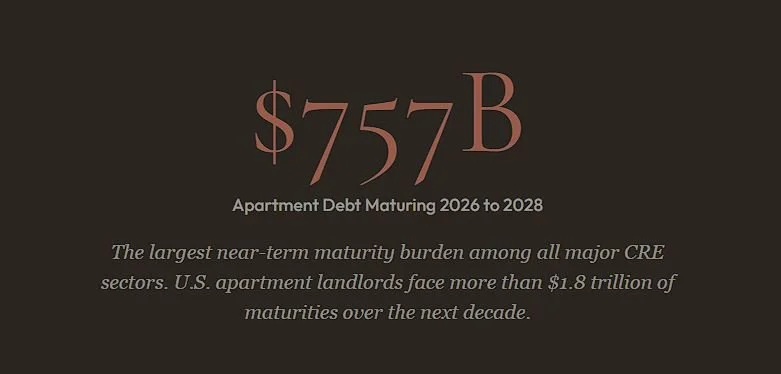
U.S. apartment landlords face more than $1.8 trillion of debt maturities over the next decade. During 2020 and 2021, apartment financing could be obtained at roughly 3%. Those transactions were often underwritten alongside rapid rent growth and rising valuations. Now some borrowers are looking at refinancing costs closer to 6%. A loan does not need to default for that difference to matter.
01 — The Rate Gap Is Mechanical, Not Theoretical
Debt Service Has Effectively Doubled on the Same Property
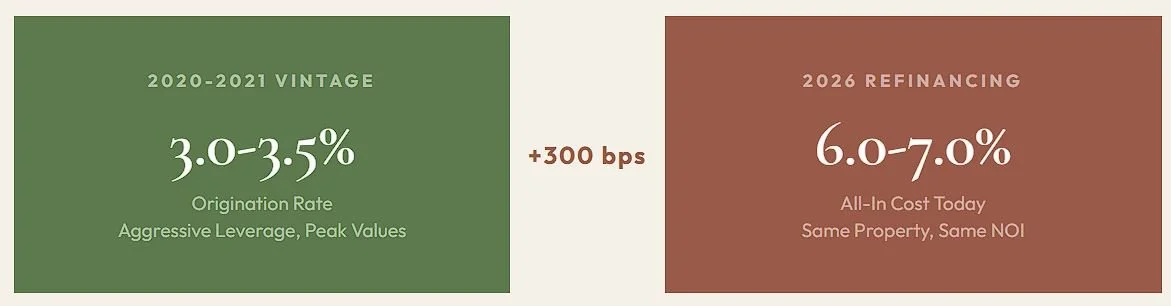
A 200 to 300 basis point rate increase compresses new take-out proceeds by 25 to 35% at constant NOI and constant DSCR. A loan that originally sized at 70% LTV may only qualify for 60 to 65% today. The gap between the existing balance and what the new loan covers is the equity the borrower must bring, or the trigger for a workout. An estimated 25 to 40% of 2020 to 2022 vintage loans will not qualify for permanent debt at current rates without fresh equity.
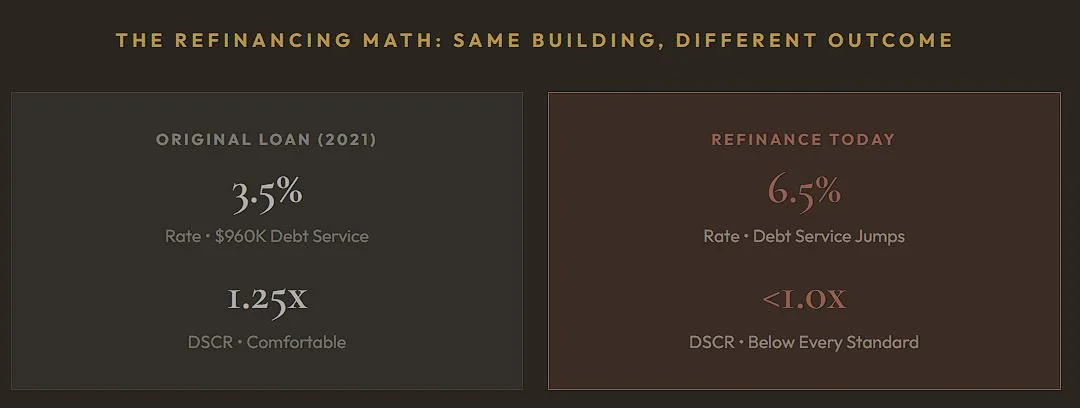
50-unit building. $1.2M NOI. Nothing changed about the building. Everything changed about the debt.
02 — Delinquencies Have Nearly Quadrupled
And Most Are Term Defaults, Not Maturity Defaults
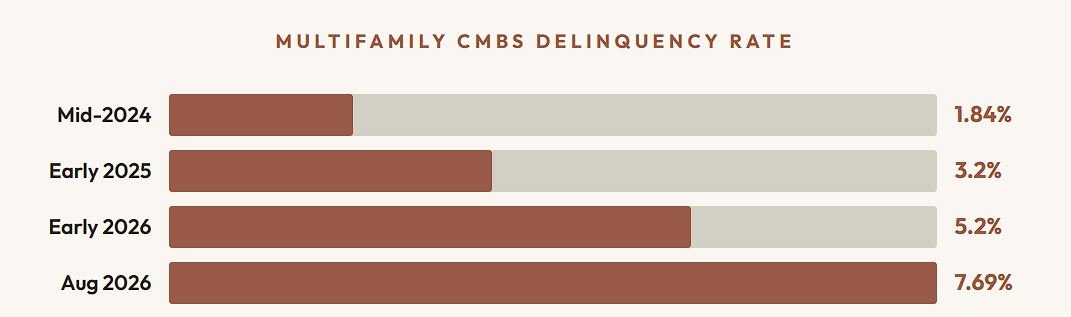
Highest since the aftermath of the financial crisis. Special servicing rate: 8.37%. CRED iQ projects overall CRE distress could reach 15% by December 2026.
Most new multifamily delinquencies in recent months were term defaults, not maturity defaults. Borrowers are not just struggling because their loans are coming due. Some are struggling because operating costs, insurance, and debt service have eroded cash flow even before the maturity date arrives. The weighted average remaining term on newly delinquent loans was just over three years.
“This is not only a refinancing problem waiting at maturity. For the most stressed capital structures, it is a cash flow problem happening right now.”
03 — The Part Most Headlines Miss
Operational Distress and Refinancing Distress Are Not the Same Problem
Imagine an apartment property that still has tenants, still collects rent, still maintains occupancy, and still produces positive operating income. The underlying asset may be functioning exactly as intended. But if the original acquisition relied on aggressive leverage, low interest rates, continued rent growth, or a future refinance at favorable terms, today's capital structure can still fail the refinancing test.
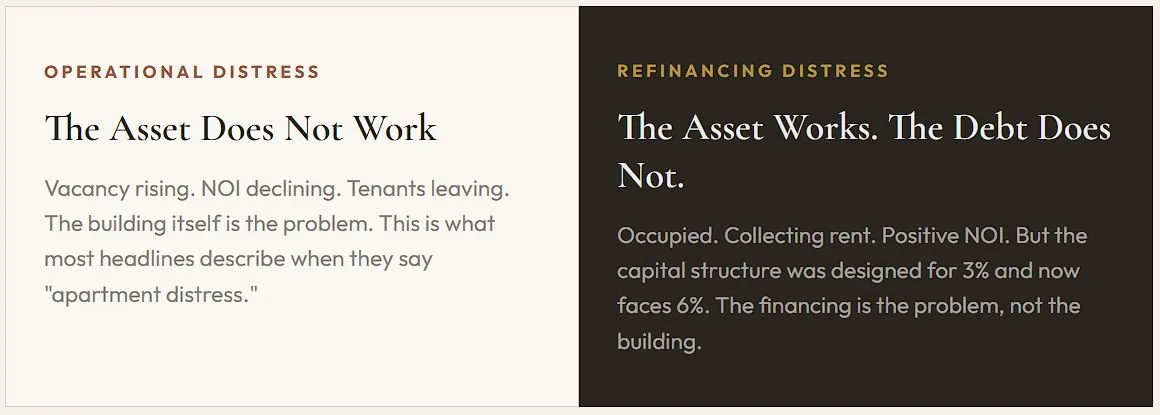
When the new loan cannot replace the old loan dollar for dollar, someone has to fill the gap. The owner contributes additional equity. A new investor recapitalizes the property. The lender modifies or restructures the loan. The property is sold. Or, in the weakest cases, control ultimately changes hands.
For several years, the central question was: when will rates come down enough to refinance? The better question now may be: who has enough equity to refinance if they do not?
04 — What We Are Watching
Four Variables That Determine Where Opportunity Forms
-
Can current property income support refinancing at today's rates without assuming aggressive future rent growth?
-
How much additional capital are lenders requiring borrowers to contribute? The gap between the old balance and the new loan is the measure of stress.
-
More maturity-driven sales would accelerate price discovery and create entry points for well-capitalized buyers.
-
If an otherwise viable property changes hands because the old capital stack cannot survive, the new owner's entry basis may matter more than the previous owner's loss.
The same market can contain a healthy apartment community, an overleveraged owner, a cautious lender, and an attractive recapitalization opportunity simultaneously. Understanding which part of that equation is actually distressed is what separates positioning from headline reading.
Closing Perspective
Underwrite Both the Asset and the Financing
The maturity date itself is not the investment thesis. The capital structure underneath it is. Properties with conservative leverage, durable occupancy, and sufficient debt-service coverage enter the cycle from a fundamentally different position than properties purchased at peak valuations with aggressive leverage.
“The asset and the financing are not the same investment. Underwrite both.”