

Inflation Cooled. Hike Odds Fell. The 10-Year Hit a 24-Year High Anyway.
Yesterday's inflation report was the best news the Fed has had in months. The bond market ignored it. For anyone underwriting real estate or infrastructure debt, that is the more important signal.
Core PCE, the inflation measure the Fed actually targets, came in at 3.0% for August. Consensus was 3.3%. The monthly reading was 0.2%, also below forecast. Markets responded by cutting the odds of an October hike roughly in half. This morning, the 10-year Treasury rose to 5.34%. That is the highest level since 2002. The 30-year broke above 5.65%. Over the third quarter, the 10-year climbed 87 basis points, the largest quarterly increase since early 1994.
Inflation cooled. Fed expectations eased. Long-term borrowing costs went up anyway. Something other than the Fed is now setting the price of long-duration debt.
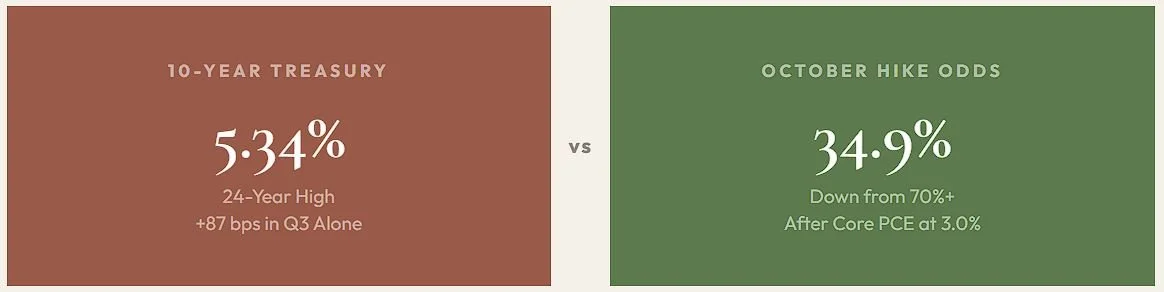
One went to a 24-year high. The other fell by half. In a normal cycle, they move together.
01 — Why the Gap Matters
The Lever Has Slipped
Most real estate underwriting still treats the Fed as the lever that sets refinancing costs. This week showed that lever has slipped.
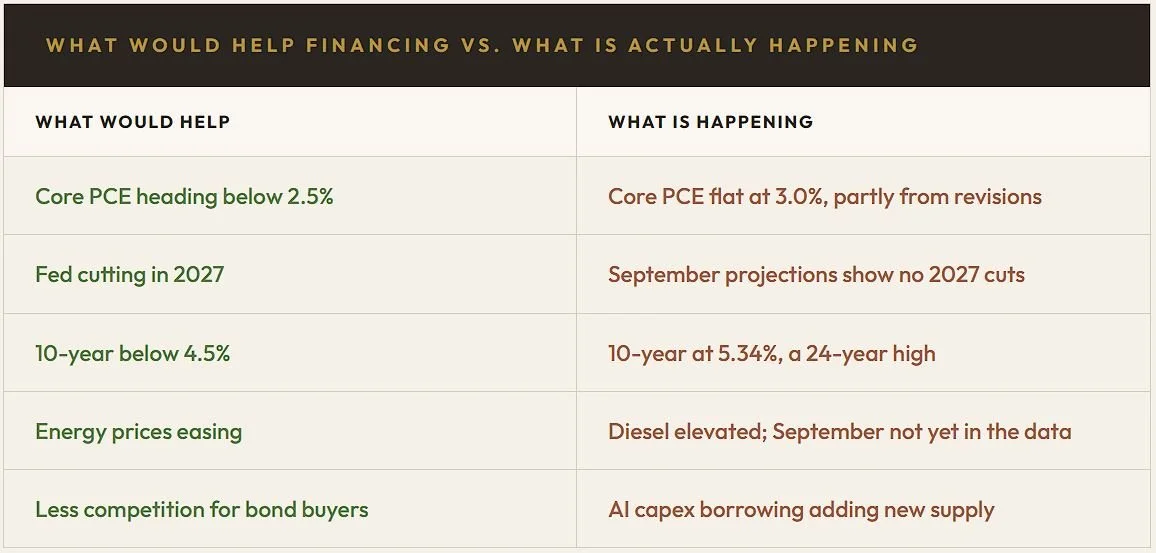
The Fed side improved. Core PCE at 3.0% is still a full point above the 2% target. But it held flat for a third month, and the trend was revised lower. On this read, the Fed can afford to wait.
Part of the improvement was a ruler change. The Commerce Department's annual revisions changed how it measures portfolio management fees, software, and computer prices. July core PCE went from 3.3% to 3.0% on paper. Prices did not change. The measurement did. Governor Michael Barr noted this week that he has seen only two months of data consistent with 2% core inflation in the last 20.
The inflation gap still runs backwards. Core CPI is 2.4%. Core PCE is 3.0%. Historically, PCE runs at or below CPI. Housing explains most of it: shelter is roughly a third of the CPI basket but closer to a sixth of PCE. The index the Fed targets is the one that housing helps least.
The easy read: inflation is cooling, the Fed is done, refinancing relief is coming. The correct read: the Fed may be close to done, and it may not matter.
02 — What Is Pushing the Long End Higher
Three Forces the Fed Does Not Control
-
The Iran conflict has kept oil and diesel elevated all year. Investors buying a 10-year bond are pricing what inflation looks like over the next decade, not what it looked like in August. The August PCE report also predates September's jump in diesel prices.
-
The Treasury has to sell a heavy volume of debt to fund deficits. Buyers want more compensation to absorb it. The Treasury's buyback program was meant to slow the rise in yields; analysts say it is too small to matter in a market of more than $30 trillion.
-
AI Borrowing
Corporate bond issuance to fund the AI build-out has added to the supply of debt competing for the same pool of investors. Every new data center bond asks the same investors for capital that would otherwise go to Treasuries or mortgage debt. Housing debt and AI debt now compete for the same buyers.
Then add the layer that sits on top of all three: lender spreads. Mortgage and commercial real estate loans price at a spread over Treasuries. That spread depends on credit conditions, bank capital rules, and risk appetite. Spreads can widen even when base rates fall.
03 — Follow the Capital
The Refinance Assumption Needs a New Reason to Exist
The September data already removed the 2027 refinancing tailwind. This week removed the hope that a pausing Fed would bring it back.
In June, the Fed's median projection put the funds rate at 3.6% by end-2027. In September it moved to 4.1%, with no cuts until 2028. That is 50 basis points of projected relief gone. Even if the Fed pauses in October, the long end is now trading on its own drivers. Any model that assumes cheaper permanent debt by 2027 is assuming the bond market reverses, not the Fed.
The barbell has two legs, and this week they touched. Borrowing to build AI infrastructure is part of what is pushing up the yields that price workforce housing loans. Both sides of the portfolio are downstream of the same rate.
On September 21, Texas Governor Abbott ordered the state's environmental regulator to halt all permits sought by data center projects until the grid operator's audit is complete. Higher rates plus an open-ended permit pause is a hard combination for any project still in development.
04 — What We Are Watching
Four Data Points That Shape the Near Term
-
A strong report revives the October hike case. A weak one tests whether the long end can fall even when growth slows.
-
If hike odds keep falling and the 10-year keeps rising, the decoupling is confirmed. That is the scenario underwriting should be built for.
-
Regulators owe the governor a compliance update on the permit pause. Watch for any carve-out for projects with permits already in hand.
-
The first inflation report to capture September's diesel move. This is the print that tests whether the August improvement holds.
The IGC Takeaway
The Fed is no longer the only rate that matters. Inflation cooled. The Fed's next move got less certain. And the 10-year still made a 24-year high. Energy, deficits, and AI borrowing are now setting the floor under long-term debt, and none of them answer to the FOMC.
For underwriting, that means the refinance has to work at today's rates, not the rates a model hoped for in 2027. The assets that hold up are the ones whose income does not depend on a rate cycle turning.
Workforce housing tenants pay rent because they need a place to live. Infrastructure contracts that pay regardless of usage, backed by a counterparty that can pay, hold up for the same reason.
“The barbell holds.”