

National vacancy fell for the third consecutive quarter. Absorption is up 14% year over year. Construction starts hit 2016 lows. And Class C apartments, the segment nobody is building, have the lowest vacancy in the entire market.
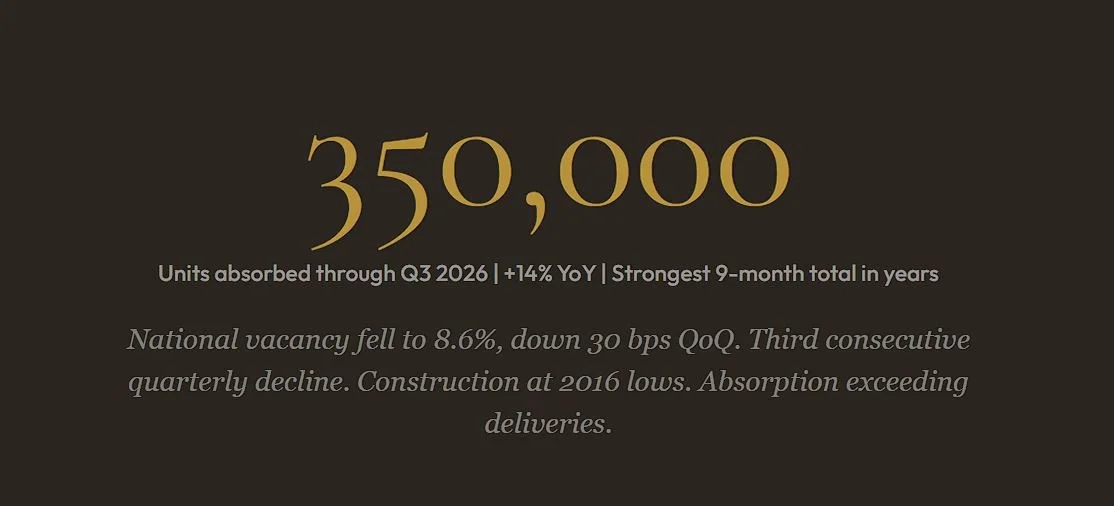
Two reports published this week quantify the same conclusion from different angles. Cushman & Wakefield's Q3 2026 national multifamily report shows vacancy dropping 30 basis points quarter over quarter to 8.6%, the third consecutive decline. NAR's October Commercial Real Estate Market Insights report adds the class-level detail that matters most: Class C apartments have the lowest vacancy among all three classes.
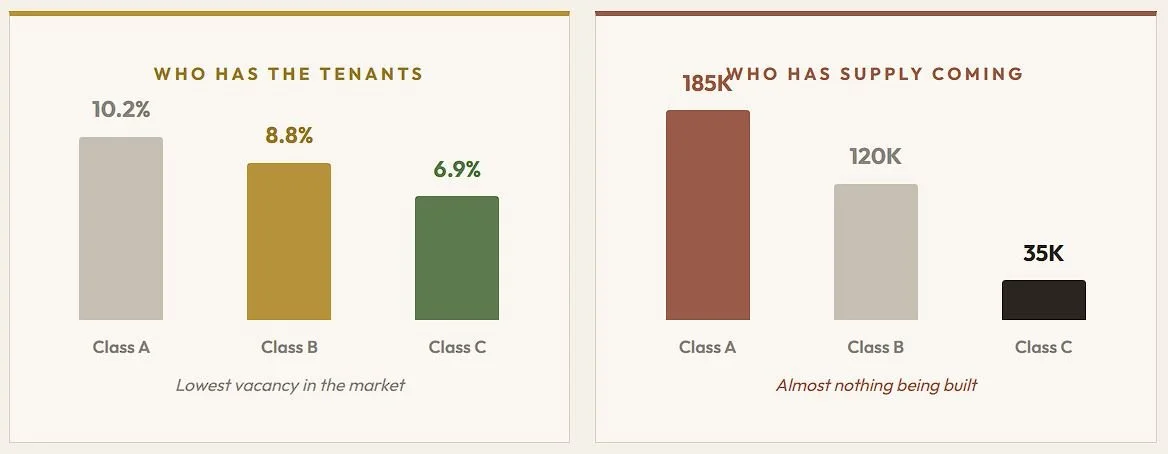
Source: NAR October 2026, Cushman & Wakefield Q3 2026, Apartment Loan Store Q2 2026.
The Data Is Now Specific Enough to Underwrite Against
-
NAR's October data shows Class C retaining the lowest vacancy among all three classes while returning to slightly positive absorption. These are the workforce-priced units where tenants renew because they have no affordable alternative, not because the amenity package impresses them.
-
The middle of the market is stable. Tenants are not trading down from Class A in large numbers, but they are not leaving either. Rent growth is beginning to gain traction after being flat for over a year.
-
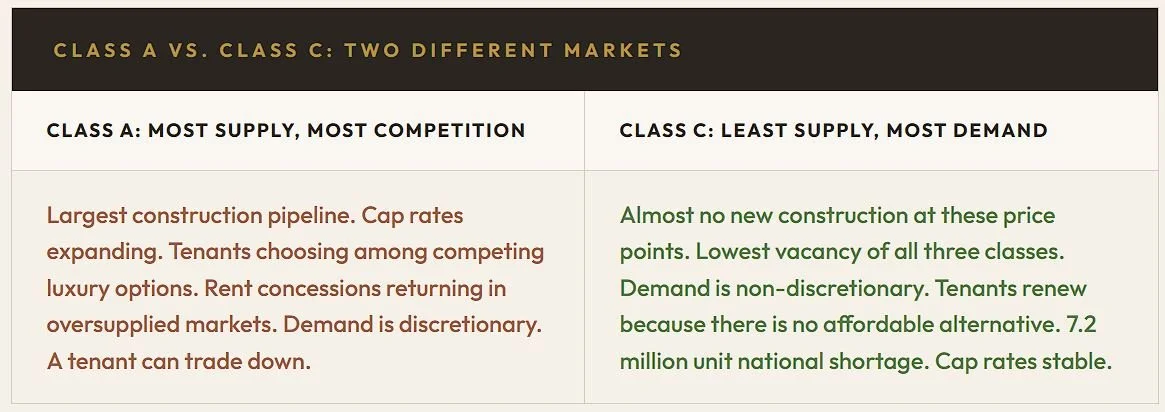
The construction pipeline is overwhelmingly Class A product. Approximately 185,000 of the 392,000 units under construction are Class A. Cap rates expanded 5 bps in Q2 for both A and B, while remaining stable for C.
The construction pipeline is contracting at the fastest rate since the recovery. Starts fell 30% year over year. The pipeline dropped from 529,000 units in 2022 to 392,000 today. At current absorption rates, the market will absorb the remaining pipeline within 12 to 18 months.
The supply wave that worried every multifamily investor for three years is ending. Deliveries are falling. Starts are at 2016 levels. Absorption is up 14%. And the segment with the least new supply, Class C workforce housing, already has the lowest vacancy in the market.
Class C Demand Is Not Discretionary. It Is Structural.
Consumer sentiment is bifurcating. This week's data shows sentiment falling steeply among lower-income households while higher-income spending continues. When lower-income households are under financial stress, they do not stop renting. They cannot. They have no alternative. They do not buy homes at $440,600 median and 7%+ mortgage rates. They do not move to cheaper markets because their jobs are local. They stay. They renew. They absorb.
That is why Class C has the lowest vacancy. The tenant does not choose to live there because the building is attractive. They live there because it is the most they can afford. And 7.2 million more households need an affordable home that does not exist.
The Capital Is Following the Data
-
First ever issuance. Backed by 26 floating-rate bridge loans across multifamily and industrial. A new issuer entering the market signals capital formation, not retreat.
-
Largest residential transition loan multifamily securitization to date. Genesis Capital originated the loans. Capital markets infrastructure for multifamily bridge lending is expanding.
-
Multifamily and industrial across Atlanta, Columbus, and Dallas. Institutional capital deploying into the segment where fundamentals are improving.
Three Variables That Determine What Happens Next
-
If absorption continues outpacing supply, vacancy falls further and rent growth follows. The rebalancing accelerates.
-
Rents at the bottom have been flat or slightly negative. If vacancy tightens further, pricing power returns to the segment that has been most constrained.
-
If starts remain at 2016 levels through mid-2027, the supply shortfall deepens. Every quarter without new starts extends the runway for existing assets.
The IGC Takeaway
The cheapest apartments are the fullest. Nobody is building more of them. And the tenants who live there have nowhere else to go.
Class C has the lowest vacancy. The construction pipeline is at 2016 lows. Absorption is up 14%. The supply wave is ending. And the structural shortage of 7.2 million affordable homes has not changed.
At IGC, we did not wait for the data to confirm the thesis. We positioned in workforce housing because the demand is non-discretionary, the supply is structurally constrained, and the income is observable every month in the operating account. This week, the market confirmed what the operating account already showed.
“The expense nobody budgeted for is repricing every deal in America. The operators who survive this repricing are the ones who saw it coming.”
Sources: Cushman & Wakefield Q3 2026 National Multifamily MarketBeat; NAR October 2026 CRE Market Insights; Apartment Loan Store; Castlelake; Rithm Capital; Hines. This material is for informational purposes only. Not investment advice.