

The expense most investors treated as a line item has become the line item. Multifamily insurance costs have nearly doubled in five years. Unlike interest rates, insurance premiums do not come down when the Fed cuts. This is a permanent repricing of what it costs to own an apartment building.
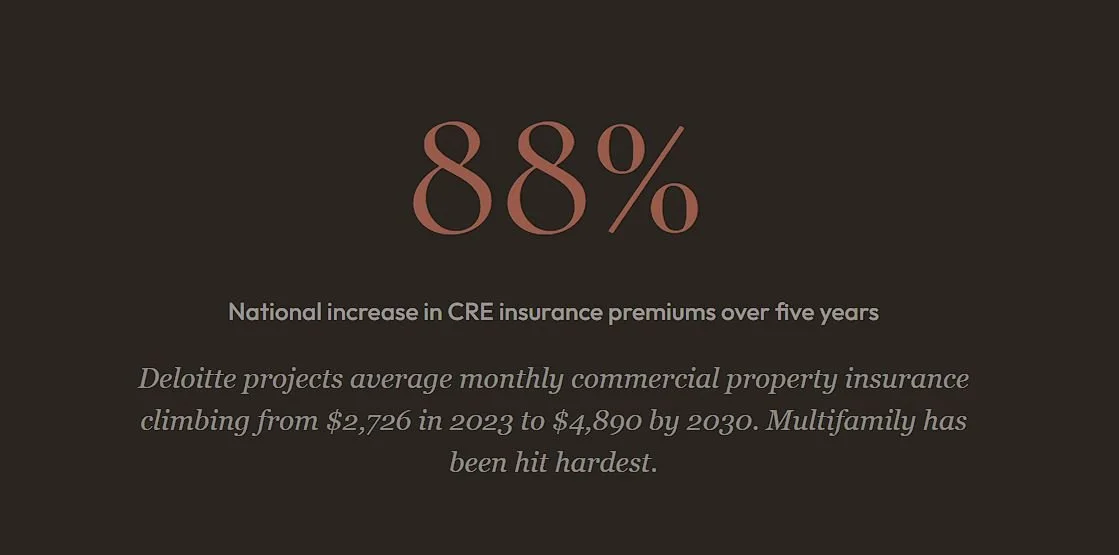
Every deal model has an insurance line. Most investors glance at it. For the past five years, that line has been the fastest-growing operating expense in multifamily real estate, outpacing rent growth, outpacing inflation, and outpacing every other cost category in the budget. The numbers are no longer incremental. They are structural.
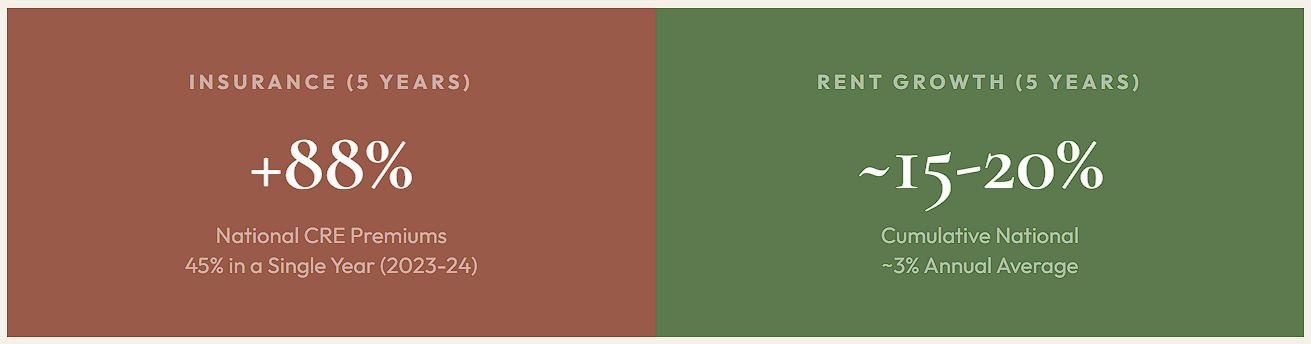
That is not a gap that closes. It is a gap that compounds.
A Line Item That Became the Line Item

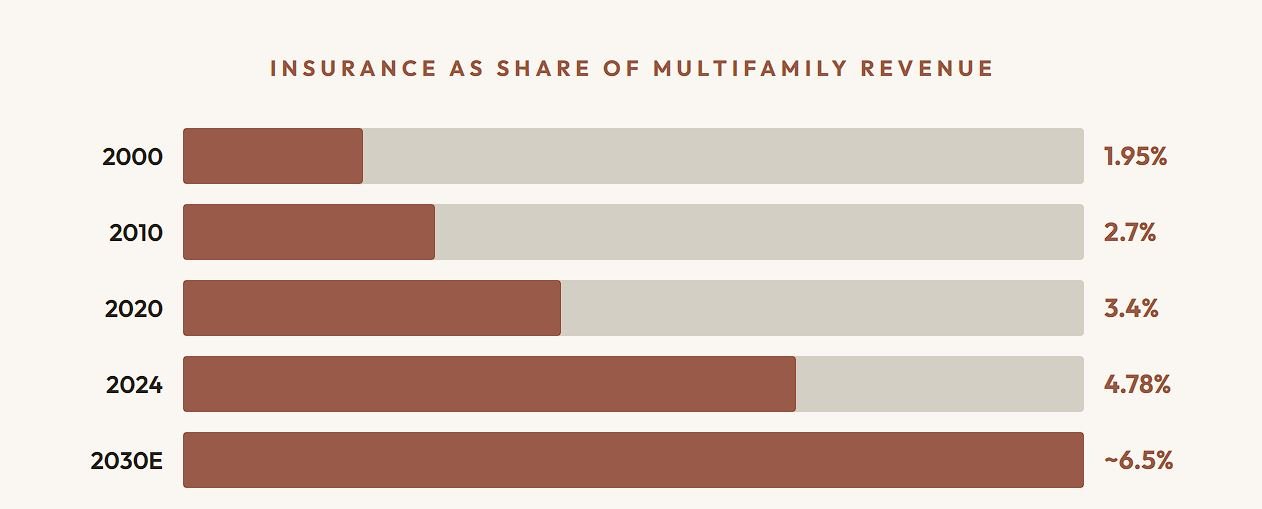
Source: NAA/IREM benchmarking data, Federal Reserve via NAA (2026), Deloitte projections.
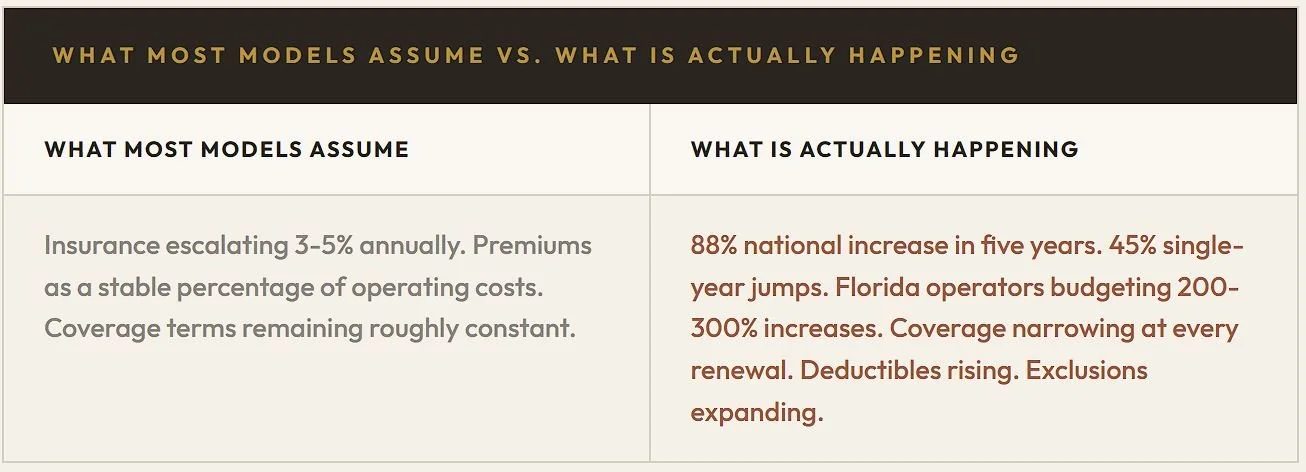
Higher deductibles, narrower coverage, and stricter underwriting are now standard at renewal. Operators are not just paying more. They are getting less coverage for more money. Wind and hail exclusions, higher named-storm deductibles, and percentage-based deductibles on catastrophe events are becoming the norm.
The Fed Cannot Cut It. Rate Relief Does Not Lower It.
Insurance costs do not respond to the same forces that drive the rest of the real estate cycle. The Fed cannot cut them. Rate relief does not lower them. A strong economy does not reduce them. They are driven by reinsurance capacity, catastrophe losses, replacement cost inflation, and climate-risk modeling, none of which are cyclical.
Then add the layer that sits on top of all three: lender spreads. Mortgage and commercial real estate loans price at a spread over Treasuries. That spread depends on credit conditions, bank capital rules, and risk appetite. Spreads can widen even when base rates fall.
03 — Follow the Capital
The Refinance Assumption Needs a New Reason to Exist
The September data already removed the 2027 refinancing tailwind. This week removed the hope that a pausing Fed would bring it back.
In June, the Fed's median projection put the funds rate at 3.6% by end-2027. In September it moved to 4.1%, with no cuts until 2028. That is 50 basis points of projected relief gone. Even if the Fed pauses in October, the long end is now trading on its own drivers. Any model that assumes cheaper permanent debt by 2027 is assuming the bond market reverses, not the Fed.
The barbell has two legs, and this week they touched. Borrowing to build AI infrastructure is part of what is pushing up the yields that price workforce housing loans. Both sides of the portfolio are downstream of the same rate.
On September 21, Texas Governor Abbott ordered the state's environmental regulator to halt all permits sought by data center projects until the grid operator's audit is complete. Higher rates plus an open-ended permit pause is a hard combination for any project still in development.
04 — What We Are Watching
Four Data Points That Shape the Near Term
The IGC Takeaway
The Fed is no longer the only rate that matters. Inflation cooled. The Fed's next move got less certain. And the 10-year still made a 24-year high. Energy, deficits, and AI borrowing are now setting the floor under long-term debt, and none of them answer to the FOMC.
For underwriting, that means the refinance has to work at today's rates, not the rates a model hoped for in 2027. The assets that hold up are the ones whose income does not depend on a rate cycle turning.
Workforce housing tenants pay rent because they need a place to live. Infrastructure contracts that pay regardless of usage, backed by a counterparty that can pay, hold up for the same reason.
“The geographic implication is becoming an investment thesis of its own. A Midwest or interior-Northeast property, lower headline rent but a fraction of the insurance load, produces a stronger, more financeable DSCR than a coastal property with higher rents and catastrophe-priced coverage.”
The Variable Nobody Modeled at Origination
A property originated in 2021 at $502 per unit in insurance now faces $850 to $920 per unit. On a 200-unit property, that is $70,000 to $84,000 in additional annual operating expense that did not exist when the loan was sized. That flows directly into the DSCR and the refinancing test.
Captive insurance structures are emerging. Real Property Captive launched with $8.3 million in committed premiums from midsize multifamily, single-family, student housing, and industrial operators. Operators are forming their own insurance vehicles because the commercial market is no longer serving them at viable prices.
Some operators are leaving markets entirely. The full PITIA calculation, principal, interest, taxes, insurance, and association fees, determines whether a deal pencils. When insurance alone moves 88% in five years, markets that worked at origination may not work at refinancing, even if occupancy and rent are unchanged.
Three Variables That Determine What Happens Next
-
A major landfall event could produce another 20 to 40% increase in the most affected states. The 2027 renewal cycle begins pricing in Q4 2026.
-
Whether alternative structures achieve scale sufficient to meaningfully reduce costs for institutional operators. Real Property Captive is the first meaningful test case.
-
Whether insurance costs accelerate the shift from coastal Sun Belt to Midwest and interior markets. The premium has become a location decision, not just a line item.
The IGC Takeaway
Insurance premiums rose 88% in five years. Rent grew roughly 15 to 20%. That math does not reverse because the Fed cuts rates. It does not improve because occupancy is strong. It compounds annually against every operating budget, every DSCR calculation, and every investor distribution.
At IGC, we underwrite insurance as a primary variable, not a line item. Our workforce housing thesis prioritizes markets where the full PITIA math produces a defensible DSCR at current costs, not at the costs that existed when the deal was originated.
The operators who survive this repricing are the ones who saw it coming.
“The expense nobody budgeted for is repricing every deal in America. The operators who survive this repricing are the ones who saw it coming.”