

What a $54 Commitment Revealed About Modern Capital Allocation
A room representing billions in family office capital. A queen speaking about her people. And in the end, $54 in commitments. The moment itself is not the story. What it reveals about how capital systems actually work is.
I just returned from the Global Family Office Investment Summit in Miami. Anthony Ritossa convenes these gatherings several times a year, bringing together family offices, sovereign wealth representatives, private investors, and global leaders in rooms where the aggregate capital represented runs into the billions.
At this year's 30th Anniversary Edition at the Trump International Beach Resort, over 300 investors gathered for two days of panels on AI, real estate, private equity, and next generation wealth. It was, by every measure, an extraordinary gathering of capital and influence.
During one session, H.R.M. Queen Diambi Kabatusuila Tshiyoyo Muata of the Democratic Republic of Congo took the stage. She spoke about her people. About the minerals beneath their land that power the technologies the rest of the world is building fortunes on. About the gap between what is extracted and what is returned. About what her communities need to build lasting resilience.
She spoke with clarity and conviction. The room listened.
I am not sharing this to criticize anyone. That is not the point, and it would miss the larger insight entirely. The allocators in that room are sophisticated. They are not callous. They deploy capital according to frameworks, mandates, and return thresholds that have been refined over generations. The $54 is not a failure of generosity. It is a signal about how capital allocation systems actually function.
And understanding that signal matters more than the number itself.
The Structural Gap Between Need and Capital
The Democratic Republic of Congo holds approximately 70% of the world's cobalt reserves, alongside vast deposits of coltan, copper, lithium, and gold. These are not niche commodities. They are the physical foundation of the modern technology economy. Cobalt goes into every electric vehicle battery. Coltan is essential for semiconductors. Copper wires every data center. Lithium stores the energy that powers the AI infrastructure buildout that hyperscalers are spending $690 billion on this year alone.
The DRC is not peripheral to the technology economy. It is foundational to it.
Yet most of the value created from these minerals accumulates thousands of miles from where they are mined. The DRC captures roughly 2% of the final product value of the minerals it exports. Processing happens in China. Manufacturing in Asia. Assembly and branding in the West. The wealth generated from Congolese soil does not return to Congolese communities in any proportion that resembles the value extracted.
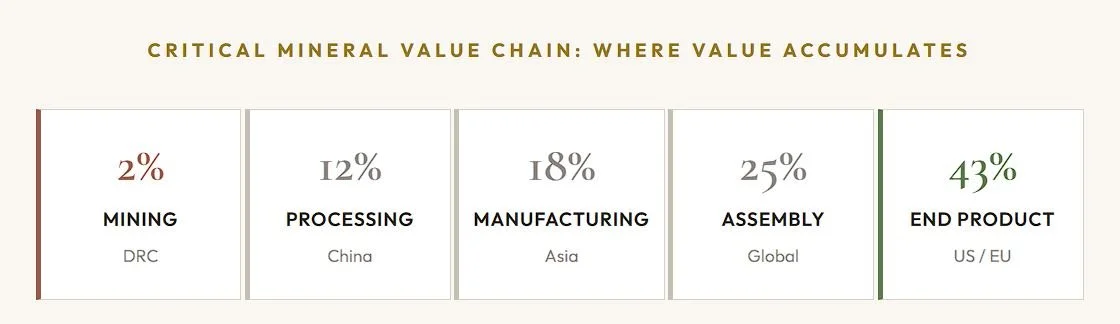
Source: OECD, IEA mineral value chain analysis. Percentages represent approximate value capture at each stage for cobalt to battery supply chain.
The $54 commitment in Miami was not a reflection of indifference. It was a reflection of the fact that capital allocation systems are built to follow return frameworks, not need frameworks. When a queen describes what her people require for lasting resilience, the room does not hear a pitch deck with an IRR. It hears a cause. And causes, in the language of institutional capital, do not get allocated to. Investments do.
This is not a moral failure. It is a structural one. And structural problems are more interesting than moral ones, because they can be redesigned.
Five Structural Lessons from the $54 Moment
-
Institutional capital does not flow toward the greatest need. It flows toward the clearest structure. A data center project in Virginia with contracted power, entitled land, and a hyperscaler lease generates immediate investor interest because the cash flow is modeled, the risk is quantified, and the return is projectable. A community infrastructure project in the DRC, regardless of how essential or how connected to the global supply chain, often lacks the financial architecture that institutional mandates require. The opportunity is not in wishing this were different. It is in building the structures that allow capital to flow where it currently cannot.
-
Mining operates on extraction timelines. Capital moves in, the resource moves out, and the value accumulates downstream. Community resilience operates on generational timelines: infrastructure, education, healthcare, housing. These are long duration investments that produce returns measured in decades, not quarters. The mismatch is not that one is more important than the other. It is that the financial system is optimized for the shorter cycle and structurally underweights the longer one. Allocators who can bridge that gap, deploying patient capital into long duration infrastructure with durable demand, will capture a category of return that most capital cannot access.
-
The family offices at GFOIS are increasingly multigenerational. The next generation of allocators is not less sophisticated than the current one. They are differently oriented. They are asking questions that their parents did not: where does this return come from, what does it sustain, and what does it leave behind? This is not idealism. It is a shift in how durability is defined. A generation that watched concentrated equity positions evaporate in 2022 and again in early 2025 is naturally drawn to investments where the value is grounded in physical necessity rather than narrative momentum.
-
The early era of impact investing often looked like philanthropy with a return expectation attached. The emerging era looks different. It looks like workforce housing that generates 8% to 10% cash on cash returns while addressing a structural housing deficit. It looks like digital infrastructure that serves AI compute demand while creating employment and tax base in underserved corridors. It looks like energy systems that power critical facilities while generating contracted revenue. The shift is from impact as a concession to impact as a structural feature of durable investment.
-
Transactional capital moves in and out of positions based on quarterly returns, market sentiment, and relative value. Transformational capital builds something that compounds over time: housing that communities need for decades, infrastructure that serves demand for generations, systems that create economic resilience in places where it did not previously exist. Both are valid forms of deployment. But the allocators who understand the difference, and who can access transformational opportunities with institutional grade structure, are building portfolios that will look very different from the consensus in ten years.
What We're Doing at Impact Growth Capital
We build around a principle that the $54 moment reinforced: capital must be deployed into structures where the demand is essential, the cash flow is observable, and the impact is a feature of the investment, not a concession made alongside it.
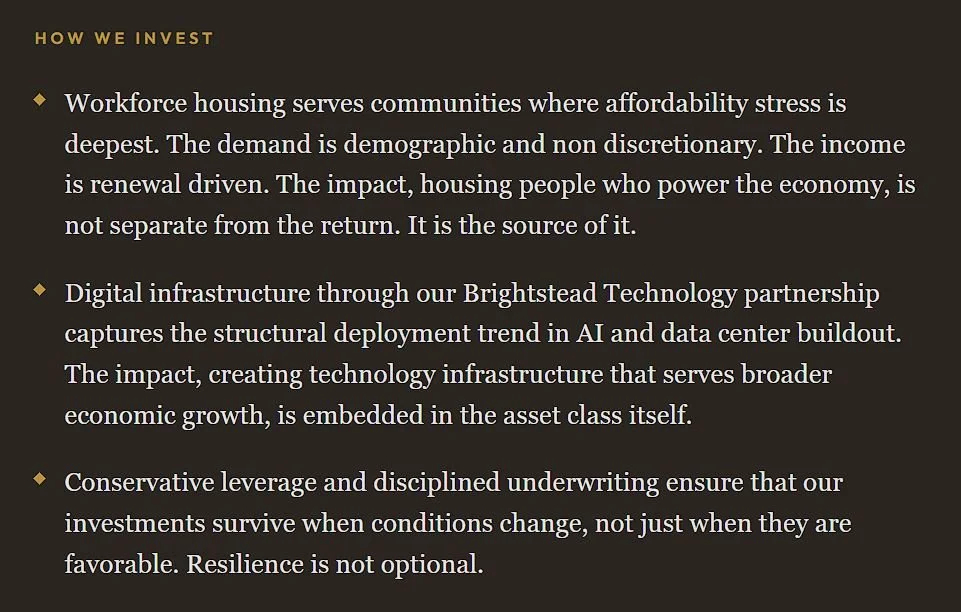
We do not invest in causes. We invest in assets where durable demand and meaningful impact are structurally inseparable. That is not a marketing position. It is an underwriting discipline.
What This Moment Means for the Future of Allocation
The $54 committed in that Miami ballroom will not change the Democratic Republic of Congo. But the moment itself may change something more important over time: how a generation of allocators thinks about where capital creates lasting value.
The global technology economy depends on minerals that come from communities with no access to the wealth those minerals create. Hyperscalers will spend $690 billion this year on AI infrastructure built with cobalt, coltan, and copper from the DRC. The disconnect between where value originates and where it accumulates is not a political argument. It is a capital allocation fact.
The allocators who recognize this are not abandoning return expectations. They are expanding the definition of what constitutes a durable investment. They are asking whether a portfolio built entirely on extraction, concentration, and short duration positioning is actually as resilient as one that includes assets grounded in essential demand, community necessity, and long duration cash flow.
The $54 moment in Miami will eventually be replaced by structured vehicles that allow institutional capital to flow into community resilience the same way it flows into data centers today. The question is how quickly that architecture gets built.
Five Signals from the $54 Moment
Capital allocation systems follow structure, not urgency. The $54 moment at GFOIS Miami reveals how institutional mandates shape where money flows, regardless of need or strategic importance.
The DRC holds 70% of global cobalt reserves and foundational deposits of coltan, copper, and lithium. It is not peripheral to the technology economy. It is foundational. Yet it captures approximately 2% of the value chain.
Impact investing is evolving from philanthropy to infrastructure. The next generation of allocators is defining durability differently, seeking investments where return and real world resilience are structurally inseparable.
Transactional capital and transformational capital serve different functions. Allocators who can access transformational opportunities with institutional grade structure are building portfolios that compound differently over time.
The opportunity ahead is not in choosing between return and impact. It is in building the financial architecture that allows institutional capital to flow into both simultaneously.
Where Capital Creates Lasting Resilience
“The future may belong not only to the allocators who identify opportunity first, but to those who understand where capital creates lasting resilience.”