

Office vacancy declined to 20.1% as 33 million square feet of obsolete inventory was removed. The housing deficit stands at 4.03 million homes. More than 90,000 apartments are now in the office-to-residential conversion pipeline. These are not two separate problems. They are one supply imbalance that disciplined capital can address.

The U.S. real estate market is undergoing a structural reset that most commentary treats as two separate stories. The office market has too much space. The housing market does not have enough. But increasingly, the solution to both problems may involve the same buildings.
The Strongest Office Recovery Signal Yet, Alongside the Deepest Housing Deficit
Cushman & Wakefield released its Q2 2026 MarketBeat showing the strongest evidence yet that the office recovery is broadening. The national vacancy rate declined 10 basis points year over year to 20.1%. Vacancy improved both quarterly and annually in 49 of 92 markets tracked. Four-quarter rolling net absorption reached a positive 14.3 million square feet, the strongest level since 2020 and the seventh consecutive quarter of improvement. Sublease availability fell 15.4% from a year earlier to 95.6 million square feet, its lowest since early 2021.
Meanwhile, total U.S. office inventory has contracted by approximately 33 million square feet over the past five quarters as older properties are converted, demolished, or repositioned. The construction pipeline stands at just 19.7 million square feet, 0.4% of total inventory, the lowest level on record this century.
The housing market faces the opposite supply problem. The United States ended 2025 with an estimated housing deficit of 4.03 million homes after more than a decade of underbuilding. Approximately 1.8 million potential Gen Z and millennial households may have delayed forming because of affordability barriers. Existing home sales declined 2.4% while the median price reached a record $440,600.
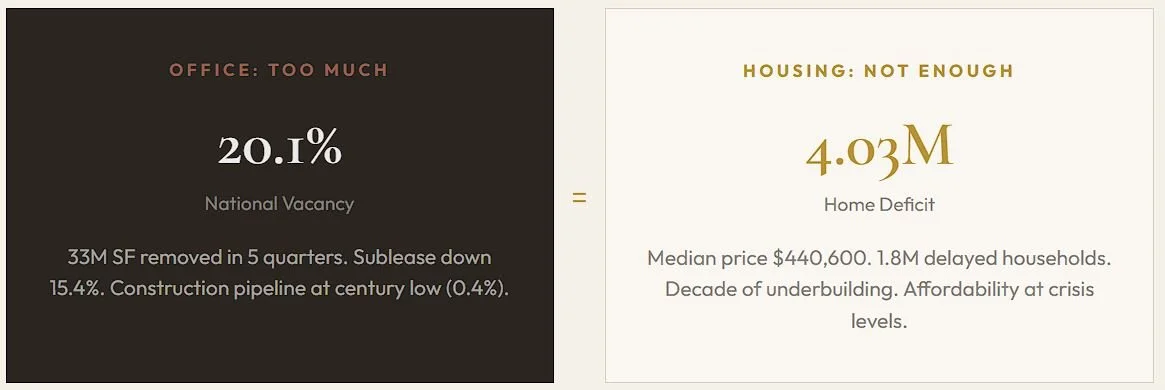
Removing obsolete offices strengthens the remaining office market by reducing excess inventory. Converting suitable buildings into apartments introduces new residents, supports downtown businesses, and adds housing without requiring entirely new sites. One action addresses both imbalances.
90,000 Apartments and Accelerating
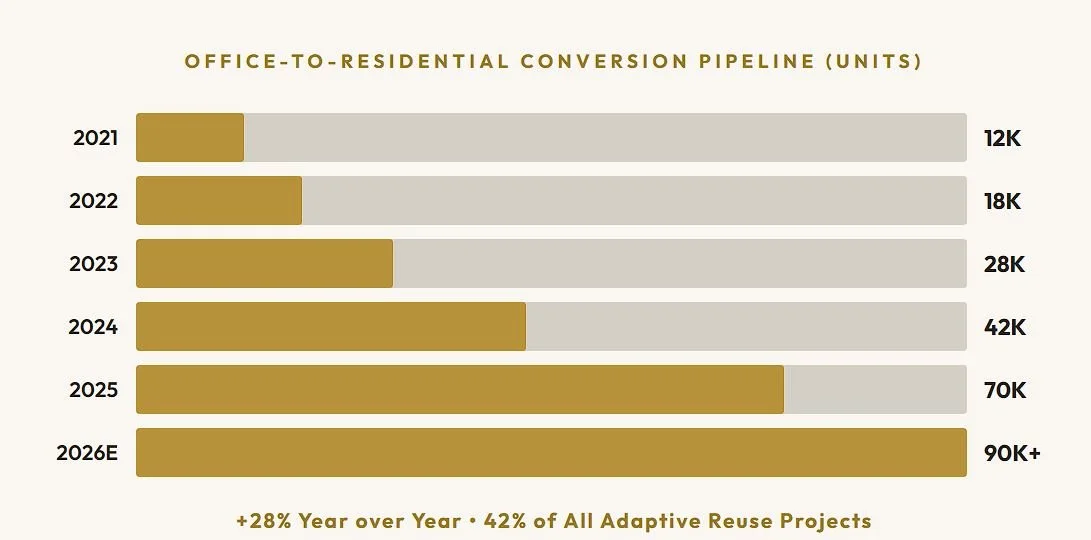
Source: RentCafe, CBRE, Cushman & Wakefield. 2026E based on current announced projects.
More than 90,000 apartments are now in the national office-to-residential conversion pipeline, up approximately 28% from the previous year. In Manhattan alone, conversion activity increased from 1.6 million square feet in 2023 to 4.1 million by August 2025, with another 8.8 million in the pipeline. Office-to-apartment conversions now account for 42% of all adaptive reuse projects, and the pipeline of future units has tripled since 2022.
Disciplined Underwriting, Not Blanket Assumptions
Not every empty office building can or should become housing. Deep floorplates, limited natural light, outdated plumbing, structural requirements, and high redevelopment costs can make some conversions financially impractical. Conversion costs typically range from $300,000 to over $500,000 per unit. Local zoning, tax incentives, financing conditions, and the building's acquisition price are often as important as its vacancy level.
The strongest opportunities involve properties that can be purchased below replacement cost, are located near employment and transportation, and can support a combination of market rate and workforce housing. This requires disciplined underwriting, not a blanket assumption that every distressed office tower can become a successful apartment building.
Case Study: What Went Wrong
235 East 42nd Street, Midtown Manhattan
Construction workers discovered two structural support columns buckling on the 21st floor. Multiple cracks had formed. Floors were sagging. The building, Pfizer's former global headquarters built in 1961, was being converted by MetroLoft into approximately 1,600 apartments in what was billed as the largest office-to-residential conversion in New York City history.
Several blocks of Midtown were evacuated. A frozen zone was established. Seven neighboring buildings were cleared. The project involved adding more than a dozen stories atop one tower while redesigning the other. The developer acknowledged that the added weight from widening the top floors likely caused the structural damage.
The 235 East 42nd Street incident is not an indictment of office-to-residential conversion. It is an indictment of conversion without structural discipline. The thesis remains sound. The execution must be rigorous.
Five Lessons from 235 East 42nd Street
-
Office buildings are engineered for specific load requirements. Adding residential floors or widening the footprint fundamentally changes demands on the original frame. Independent structural engineering analysis must confirm capacity before any other underwriting occurs.
-
Converting within the original envelope carries different risk than adding floors or materially changing load distribution. The 235 East 42nd Street project added more than a dozen stories. That is not a conversion. It is a reconstruction using an existing base.
-
The NYC Department of Buildings has signaled a full investigation. Investors should evaluate permitting and inspection frameworks in any market where conversions are underway. Insufficient oversight increases execution risk regardless of asset quality or developer reputation.
-
Conversion requires specialized expertise in structural engineering, adaptive reuse, and managing complexity that conventional ground-up development does not. Developer selection should prioritize demonstrated conversion experience, not just development volume.
-
A structural failure during conversion can cause cascading liability: neighboring building evacuations, business interruption claims, construction delays, and reputational damage. The insurance and bonding structure must reflect the actual risk.
What the Market Sees vs. What Allocators Should See
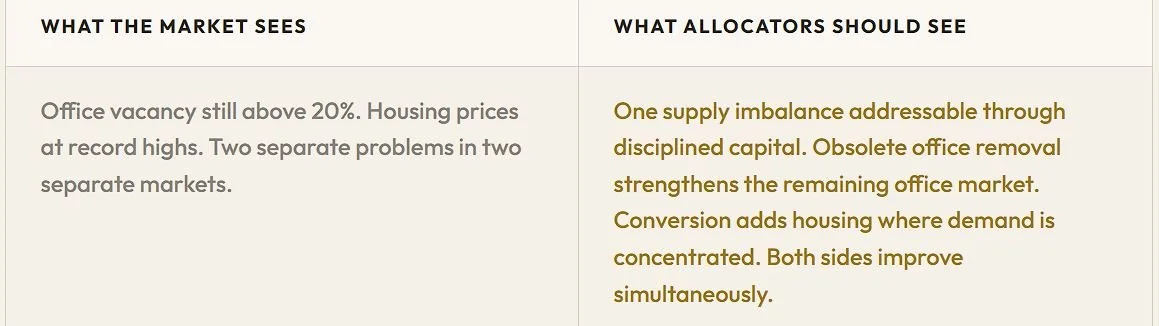
Not Just Building More. Using What America Already Has Better.
America's real estate challenge is not simply a shortage or an oversupply. It is a misallocation of existing space. Some communities have obsolete commercial properties that no longer serve their original purpose. Those same communities may lack the housing required by teachers, healthcare workers, first responders, service employees, and young families.
The opportunity is to redirect disciplined capital toward workforce and attainable housing, office-to-residential conversions, mixed-use redevelopment, adaptive reuse of obsolete properties, and communities where housing demand and employment remain durable.
Key Themes
Four Signals from the Supply Rebalancing
Office vacancy declined to 20.1% as 33M SF of obsolete inventory was removed in five quarters. Demand improved for seven consecutive quarters. The recovery is broadening beyond gateway cities and trophy assets.
The housing deficit stands at 4.03 million homes. The median price hit $440,600. 1.8 million Gen Z and millennial households may have delayed forming due to affordability barriers. The two markets share one structural imbalance.
90,000+ apartments are in the office-to-residential conversion pipeline, up 28% year over year. Conversions now account for 42% of all adaptive reuse projects. Manhattan alone has 8.8M SF in the pipeline.
The next real estate cycle may not be defined only by building more. It may also be defined by using what America already has better. Disciplined capital that addresses both the office surplus and the housing deficit simultaneously captures the most durable value.
Closing Perspective
Less Obsolete Office. More Housing. One Strategy.
Less obsolete office space can create a stronger office market and a larger housing supply. As outdated properties leave the inventory, vacancy improves for buildings that continue to meet tenant needs. When suitable properties are converted into housing, cities gain residents, businesses gain customers, and working families gain places to live.
“The next real estate cycle may not be defined only by building more. It may also be defined by using what America already has better.”