

Private Credit Is Too Big to Ignore and Still Too Opaque to Measure.
The U.S. direct lending market has grown beyond $1.3 trillion. Now the New York and Dallas Federal Reserve Banks are building a survey to understand credit availability, lending standards, and what the market means for the broader economy and monetary policy.

Private credit did not become important overnight. It became important quietly. Companies increasingly turned to direct lenders for customized financing, faster execution, confidentiality, and greater certainty that a transaction would close. Institutional capital followed in search of income and exposure outside traditional bond markets.
The result is a market now comparable in size to U.S. high-yield bonds and broadly syndicated loans but without the same public trail of prices, issuance, and standardized reporting. That visibility gap is why the Fed is stepping in.
The Market Grew Faster Than the Data
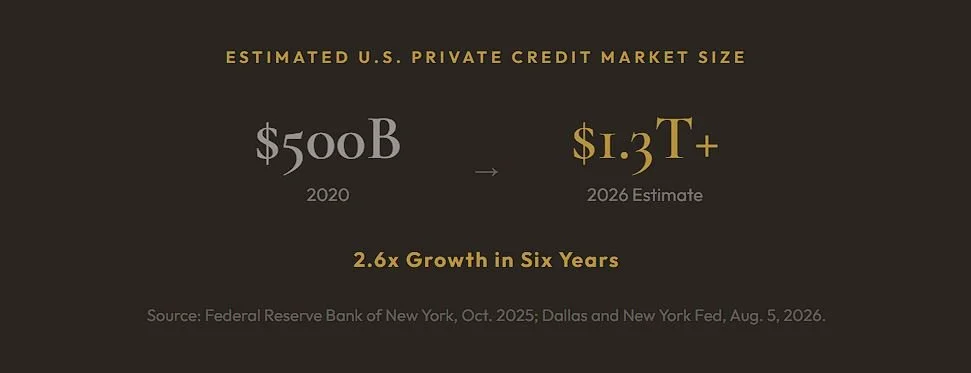
The U.S. direct lending market is estimated at more than $1.3 trillion, comparable to the high-yield bond and broadly syndicated loan markets.
Private credit has grown from roughly $500 billion in 2020 to nearly $1.3 trillion, while its share of below-investment-grade corporate debt rose materially. Unlike public credit markets, most private loans do not trade in a secondary market, limiting daily price discovery and standardized visibility.

Source: New York Fed, "The Basics of Private Credit," Oct. 17, 2025.
Credit Availability, Lending Standards, and Monetary Transmission
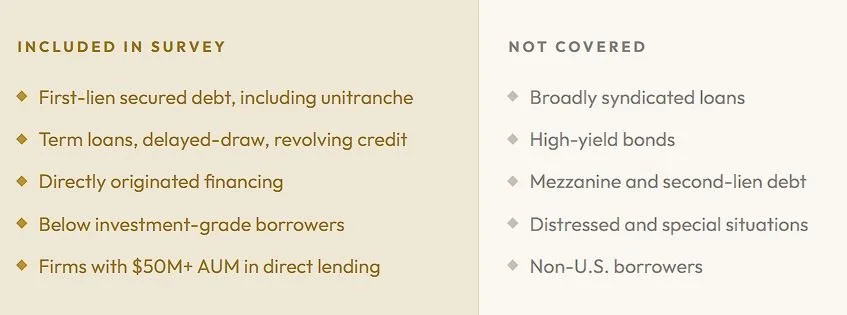
The survey is designed to provide a consistent view of credit availability, credit provision, and the evolution of lending standards across private direct lending. It will also help policymakers assess how this rapidly expanding market interacts with the economy and the transmission of monetary policy.
-
Below $30M EBITDA
-
$30M to $100M EBITDA
-
Above $100M EBITDA
Private Credit Accelerates Monetary Policy Transmission
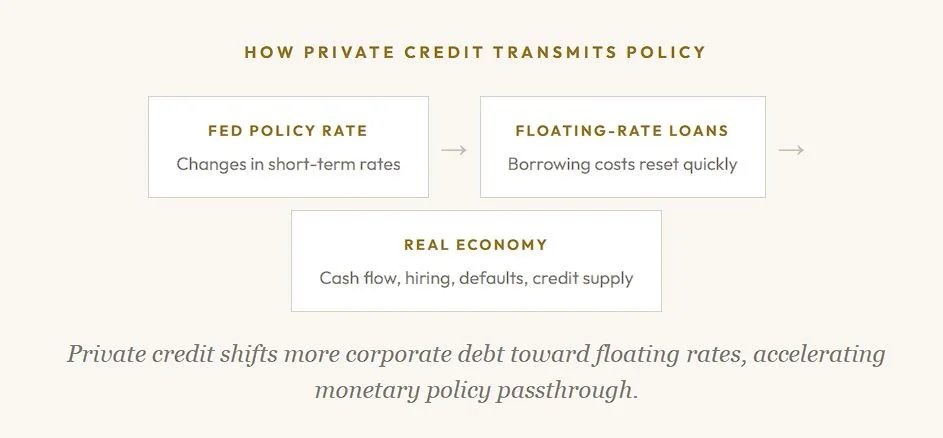
Private credit is not separate from the broader financial system. Banks lend to private credit vehicles, institutional investors provide fund capital, and floating-rate loan structures transmit policy changes to borrowers quickly. The New York Fed estimates that large U.S. banks have extended roughly $95 billion in loans to private credit lenders, with broader exposures potentially higher.
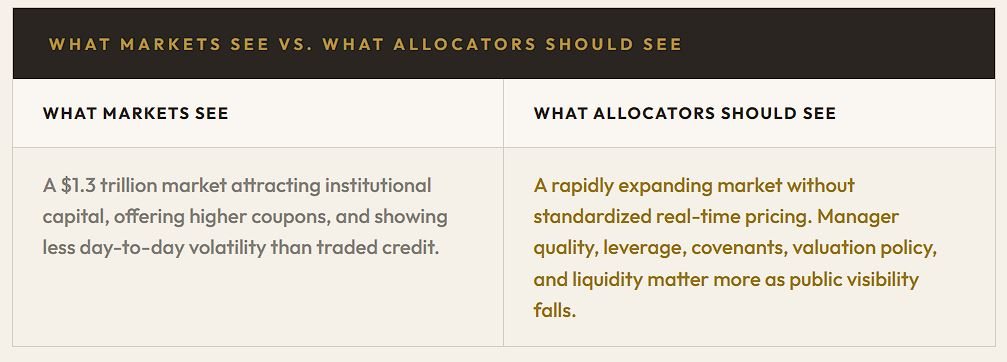
Opacity Raises the Value of Discipline
Opacity is not automatically a reason to avoid private markets. Direct lending can offer customized structures, seniority, stronger protections, and access to opportunities unavailable in public markets. But limited price discovery raises the value of disciplined underwriting and transparent manager reporting.
Private credit did not become a $1.3 trillion market because traditional finance stopped working. It grew because borrowers wanted speed, flexibility, and certainty, while investors wanted income, control, and exposure outside public markets. But scale changes the standard. Once a market rivals high-yield bonds and syndicated loans, limited visibility is no longer a niche feature. It becomes a question for monetary policy, financial stability, and institutional capital allocation.
Four Signals from the Fed Survey
Private credit is now a major capital market. The U.S. direct lending market exceeds $1.3 trillion and is comparable in size to major public credit markets.
Visibility has not kept pace with growth. Private loans do not produce the same public pricing, issuance, and trading data available in traditional credit markets.
The survey is intelligence, not enforcement. Participation is voluntary, findings will be aggregate, and the Fed says the information will not be used for supervision.
Transparency will not replace underwriting. Covenants, collateral, leverage, liquidity, valuation policy, and manager discipline remain the core protections for allocators.
Closing Perspective
Systemically Important Before the Systems Caught Up
The Fed survey may improve visibility into lending conditions, but it will not identify which loans are safe or which managers will outperform. For allocators, the less transparent the market, the more valuable disciplined underwriting becomes.
“Private credit became systemically important before the systems used to measure it caught up.”