

The $0 Housing Fix. Will It Work?
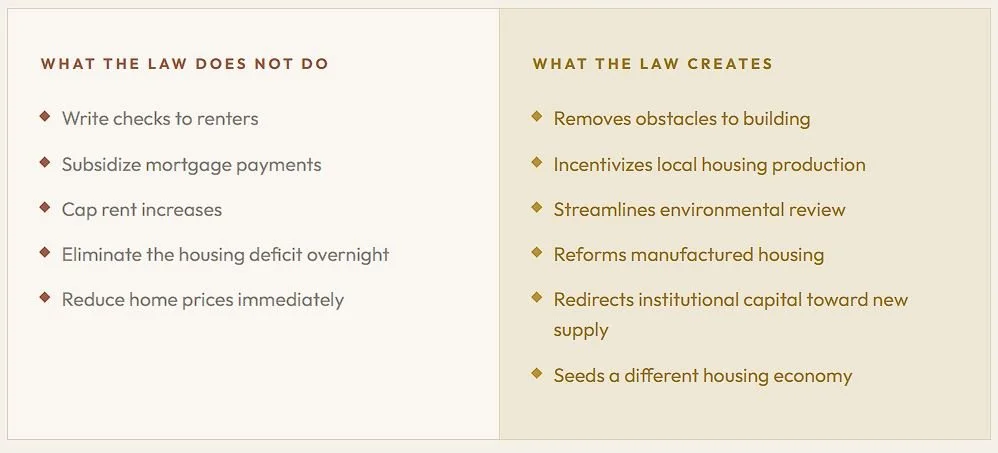
For millions of Americans struggling with rising rents or trying to buy their first home, the question about the new housing law is simple: does it change anything for me today? The honest answer is: a little now, potentially much more later. The ROAD to Housing Act will not make next month's rent cheaper. It will not suddenly make a starter home affordable. And it will not eliminate the 4.03 million home deficit overnight.
But the direction of policy matters. And the direction just changed fundamentally.
This is a supply-side bet on the future of American housing. And for allocators, understanding what it creates, when it creates it, and where the capital opportunity forms is worth more than any headline about what it does not do immediately.
Remove Obstacles. Let Capital Build.
At the center of the law is a straightforward idea: America cannot solve a housing shortage without building more housing. The legislation attempts to remove the regulatory and financing obstacles that have slowed development for decades. It creates incentives for local governments to accelerate housing production. It supports pre-approved housing designs. It streamlines certain development processes. And it creates a pilot program for converting vacant commercial and industrial properties into affordable housing.
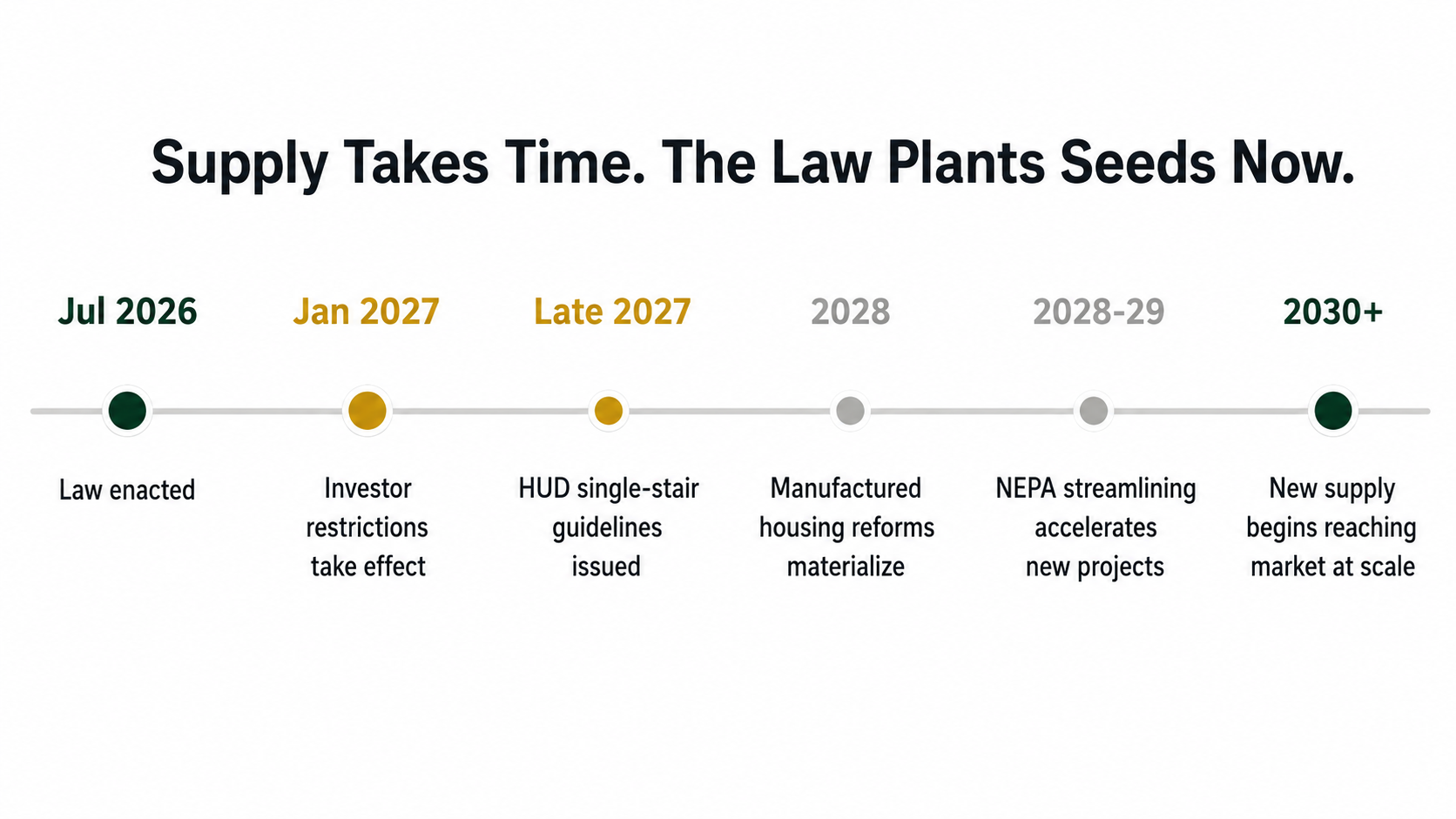
For renters, the hoped-for outcome is more competition. More apartments. More homes. More choices. Over time, additional supply could help slow rent growth and ease pressure on home prices. But supply takes time. Projects still need land, financing, permits, infrastructure, labor, and construction. Because much of the law requires new federal programs, regulations, studies, and agency implementation, some of its biggest effects could take years to fully materialize.
Source: New York Fed, "The Basics of Private Credit," Oct. 17, 2025.
Three Provisions That Do Not Require Waiting for New Construction.
-
The legislation changes rural housing programs to preserve rental assistance when certain USDA-backed mortgages mature. It also expands the Rental Assistance Demonstration program and extends protections for tenants in properties transitioning through the program. These provisions protect existing affordable housing from disappearing.
-
Mortgages of $100,000 or less are surprisingly difficult to obtain because lenders face similar origination costs whether financing a $90,000 home or a $500,000 home. The law directs regulators to examine compensation, points, and fee structures that may be limiting these smaller mortgages. That matters in lower-cost and rural markets where an affordable property may exist but financing it remains the obstacle.
-
The law eliminates the federal permanent-chassis requirement, raises certain FHA-insured manufactured housing loan limits, and supports investment in manufactured-home communities. If manufactured and modular housing can be produced more efficiently and financed more easily, they could become a significantly larger piece of the affordable housing solution, with potential cost reductions of $5,000 to $10,000 per unit.
The law is not a stimulus check for renters or a reset of home prices. It is infrastructure for a different housing economy: one where building is easier, financing is more accessible, and capital flows toward creation rather than competition for existing inventory.
Five Capital Allocation Channels the Law Reinforces
-
Communities still need housing that working families can realistically afford. The demand is structural. The policy framework is now more supportive. The capital that positions here is solving the problem the law was designed to address.
-
Regulatory and financing changes could make alternative construction models increasingly viable. This is one of the most consequential provisions in the entire Act for cost-sensitive housing production. Potential cost reductions of $5,000 to $10,000 per unit change the underwriting math significantly.
-
The pilot program for converting vacant commercial properties into housing aligns with the 90,000-unit conversion pipeline already forming nationally. Policy support accelerates a trend already underway.
-
As the investor restriction redirects institutional capital away from acquiring existing homes, new construction of purpose-built rental communities becomes the primary channel for institutional housing investment.
-
Protecting existing affordable rental stock is as important as building new units. The USDA mortgage maturity provisions prevent affordable housing from leaving the market at precisely the moment it is needed most.
Four Signals from the ROAD Act
The ROAD Act is a supply-side bet: remove the obstacles to building and let capital create the housing America needs. It does not write checks, cap rents, or reduce prices immediately. It creates infrastructure for a different housing economy.
Some provisions take effect sooner: rural rental preservation, small-dollar mortgage reform, and manufactured housing changes that could reduce costs by $5,000 to $10,000 per unit. These address affordability from the production side.
The largest effects take years: NEPA streamlining, CDBG incentives, single-stair guidelines, and the conversion pilot program all require federal rulemaking and local implementation before new supply reaches the market at scale.
For allocators, the law confirms the thesis: housing affordability is a supply problem, policy is now moving in the supply direction, and capital that positions to create housing in supply-constrained markets is solving the problem the legislation was designed to address.
The Direction Just Changed
The ROAD Act probably will not make next month's rent cheaper. But it creates the infrastructure for a housing economy where building is faster, financing is more accessible, and the policy framework rewards creation over competition for existing inventory.