

The Fed Didn't Raise Rates, So Why Did Borrowing Costs Jump?
The Federal Reserve held rates at 3.50% to 3.75%, but three policymakers voted to hike. Long-term Treasury yields climbed, energy inflation remained elevated, and Wall Street sold off. A policy pause is not the same as easier capital.
Wednesday's market reaction exposed a tension that matters far beyond the trading floor. The Fed controls the overnight policy rate. Investors set the price of long-term capital. On July 29, those two signals moved in different directions.
The Fed stayed on hold, but the bond market demanded more yield. That matters for mortgages, commercial real estate loans, construction financing, corporate credit, and the valuation of every asset priced against a risk-free benchmark.
The Policy Rate Held. The Cost of Capital Rose.
The Federal Open Market Committee voted 9 to 3 to maintain the federal funds target range at 3.50% to 3.75%. The three dissenters preferred a quarter-point increase, an unusually divided decision that reflects continuing concern about inflation and supply-driven price pressures.
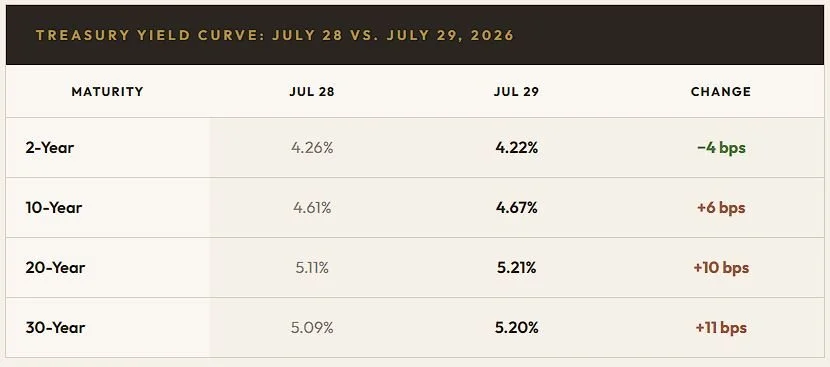
The split vote matters because it shows that the debate is no longer simply about when to cut. Three policymakers believed inflation risk was high enough to justify tightening immediately. Long-term yields rose because investors are pricing risks the Fed cannot eliminate with a single meeting: persistent inflation, heavy government borrowing, geopolitical uncertainty, and the possibility that rates remain elevated for longer than businesses and households expect.
The policy rate did not move. The cost of long-term capital did. That distinction is what matters for every asset priced against a risk-free benchmark.
Why a Hold Does Not Mean Easier Money
-
Mortgage and commercial real estate borrowing costs remain tied to long-term benchmarks, not only the Fed funds rate. The 10-year at 4.67% and the 30-year at 5.20% keep financing expensive regardless of what the policy rate does.
-
As lenders underwrite to higher debt-service requirements, the amount of capital available through refinancing declines. Borrowers expecting to extract equity on refinance face tighter math.
-
Cap-rate compression requires declining long-term yields. With the curve steepening, cap-rate pressure can persist even when the Fed is no longer raising its target rate.
Cooling in Places, But Energy Risk Is Back
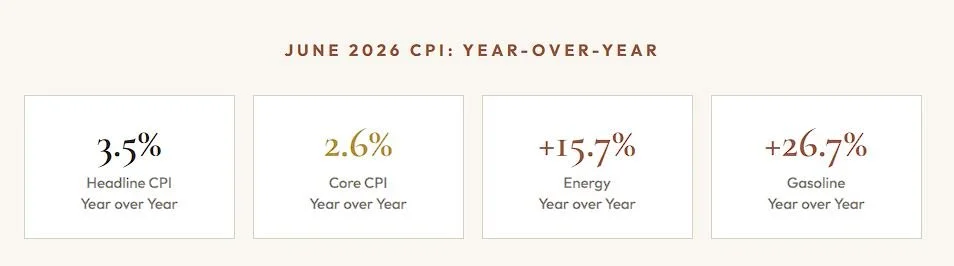
June's CPI report showed meaningful monthly relief: the all-items index fell 0.4%, energy declined 5.7%, and core prices were unchanged. But the year-over-year picture remains uncomfortable. Headline inflation is still above the Fed's 2% goal, and energy prices are materially higher than a year ago.
Brent crude jumped 7.3% on July 29 and settled above $88 per barrel as renewed conflict involving Iran increased concerns about energy supply. A sustained oil shock would feed into transportation, utilities, construction materials, food distribution, and household budgets. That is why the Fed's statement specifically highlighted supply shocks and energy-related price increases.
Washington Is Leaning Harder on Short-Term Debt
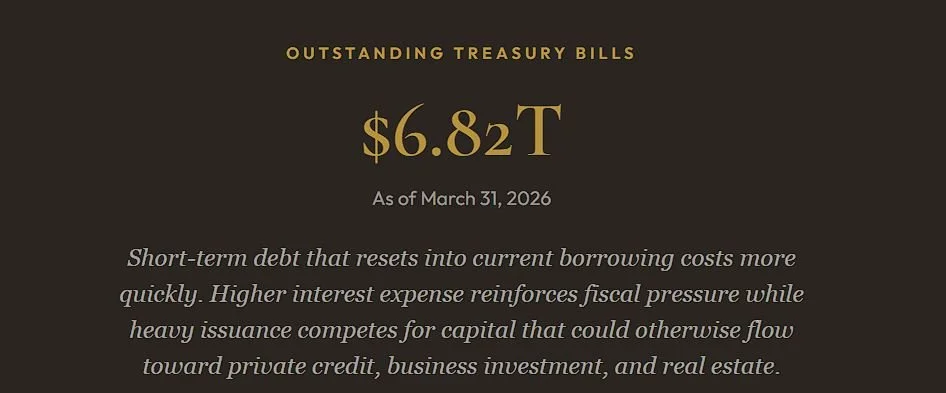
Source: U.S. Treasury Q2 2026 TBAC presentation.
The Fed is trying to balance an economy that remains active with inflation that is still above target. At the same time, the Treasury is refinancing a larger short-term debt load and the bond market is demanding higher long-term yields. That combination narrows the path to lower borrowing costs. Even if the Fed eventually cuts, long-term rates may remain elevated if investors continue to demand compensation for inflation, fiscal supply, and duration risk.
Perform Without Requiring a Cut
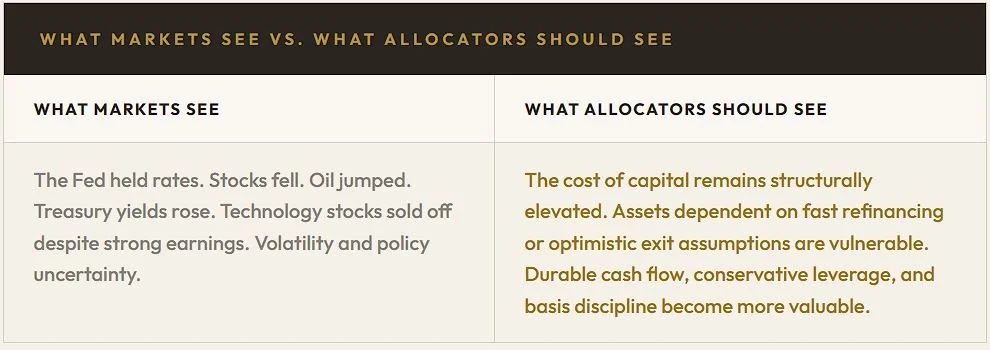
Energy costs hit households first. Higher interest rates hurt longer. For workforce housing and essential real assets, the near-term impact shows up through debt service, insurance, utilities, construction costs, and resident affordability. The longer-term impact appears in refinancing gaps, delayed transactions, and a wider divide between well-capitalized owners and overleveraged borrowers.
The opportunity is not to predict the exact timing of the next rate cut. It is to acquire and structure assets that can perform without requiring one.
Four Signals from July 29
The Fed held, but dissent grew. Three policymakers preferred a 25-basis-point hike, signaling that inflation concerns remain active inside the committee.
The long end moved higher. The 10-year reached 4.67% and the 30-year 5.20%, keeping pressure on mortgages, CRE loans, and valuations.
Energy remains the inflation wildcard. Energy CPI was up 15.7% year over year, while Brent crude jumped 7.3% in one session.
Treasury bill supply is historically large. Approximately $6.82 trillion was outstanding as of March 31, increasing sensitivity to short-term refinancing costs.
A Pause Is Not Relief
A Fed pause can stop the policy rate from rising without making money cheaper. On July 29, the bond market demonstrated that distinction in real time. The market is asking investors to underwrite for a world in which inflation remains uneven, government borrowing stays heavy, and financing costs decline more slowly than expected.
“The next cycle will reward investors who can survive expensive capital long enough to benefit from the opportunities it creates.”