

Oil Fell 5%. Real Estate Capital Is Still Expensive.
Crude dropped sharply as markets priced a possible easing of U.S.-Iran tensions. Treasury yields moved lower too, but the 10-year remained near 4.7%. The relief is real. Cheap capital is not.
Monday's market move looked like relief. Oil fell, stock futures rose, and Treasury yields eased as investors responded to the possibility of diplomacy and a reopening of the Strait of Hormuz. But the benchmark for long-term real estate capital remained close to 4.7%. Energy risk can disappear from a screen in hours. Loan pricing, debt-service coverage, lender standards, and property valuations reset much more slowly.
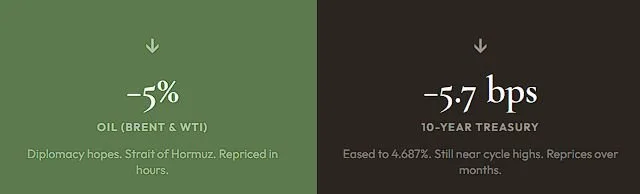
Relief Moved Oil Faster Than Capital
U.S. crude and Brent each fell about 5% as the market reduced the immediate risk of further disruption in the Persian Gulf. At the same time, the 10-year Treasury yield declined 5.7 basis points to 4.687%, while the 30-year fell by more than 5 basis points to roughly 5.22%.
Lower oil prices reduce one source of near-term inflation pressure. That can support bonds because investors require less compensation for the risk that energy costs will spill into transportation, production, and consumer prices. But the bond market did not signal a return to cheap money. The long end eased from elevated levels rather than resetting to a fundamentally different regime.
A 5% Decline Does Not Erase Five Months of Elevated Costs
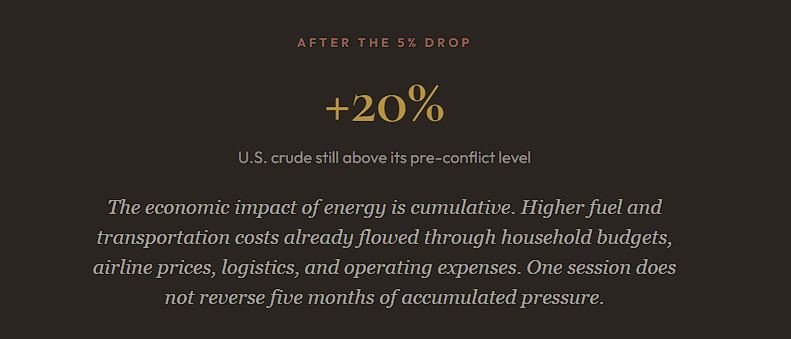
For workforce housing and essential real assets, energy volatility reaches beyond the utility bill. It can affect repair costs, contractor travel, construction inputs, waste service, insurance assumptions, and resident affordability. Lower oil is constructive. But one session does not immediately reverse accumulated operating pressure or restore purchasing power.
The Benchmark Is Still High. Credit Adds a Second Layer.
The 10-year Treasury ended July near 4.68% and traded around 4.687% on Monday morning. The 20-year and 30-year yields remained above 5.2%. Those levels continue to influence fixed-rate mortgages, commercial real estate loans, private credit, and discount rates used in valuation.
-
Fixed-rate CRE debt still begins with long-term Treasury benchmarks plus a lender spread. A move of several basis points helps at the margin, but it rarely transforms a weak acquisition or refinance.
-
Loan proceeds remain constrained when debt-service requirements are underwritten against base rates near 4.7%. Borrowers expecting proceeds at 2023 levels face a structural gap.
-
Real estate borrowers do not receive the Treasury rate. Lenders add compensation for credit risk, liquidity, property type, leverage, structure, and execution uncertainty. Even when the risk-free benchmark falls modestly, lender spreads and underwriting standards can keep all-in coupons elevated.
A lower oil price can reduce one source of inflation risk. It does not remove duration risk, lender spreads, or property-level risk. The path to easier financing requires lower benchmarks, stable inflation expectations, tighter credit spreads, and lenders willing to provide proceeds on workable terms.
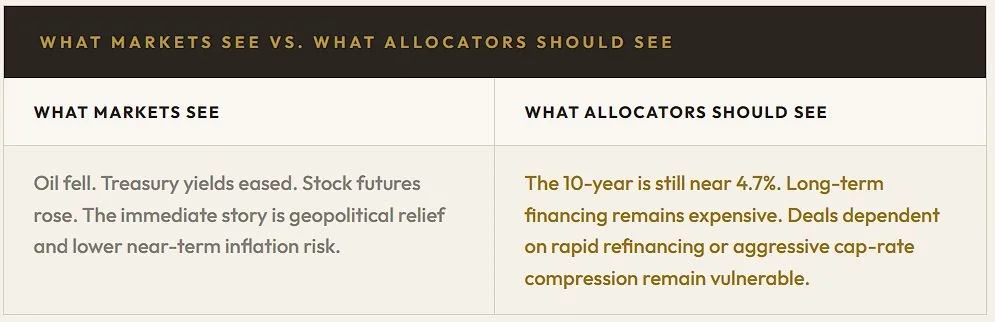
Perform While Capital Remains Expensive
Energy costs move through operations quickly. Financing costs move through valuations slowly and persistently. For workforce housing and essential real assets, lower oil can help utilities, transportation, repairs, and resident budgets. But elevated Treasury yields still shape debt service, refinancing proceeds, transaction volume, and the divide between well-capitalized owners and overleveraged borrowers.
The opportunity is not to predict the exact day capital becomes cheap. It is to acquire and structure assets that can perform while capital remains expensive.
05 — Key Themes
Four Signals from the Session
Oil fell on diplomacy hopes. Brent dropped more than 5% as markets priced a lower risk of immediate supply disruption in the Persian Gulf.
Yields eased, but remained elevated. The 10-year traded at 4.687%; the 30-year remained around 5.22%. The bond market eased from elevated levels rather than resetting to a different regime.
The energy shock is not fully reversed. U.S. crude remained about 20% above its pre-conflict level after the decline. Five months of accumulated cost pressure does not disappear in one session.
Financing relief is incremental, not structural. Durable cash flow, conservative leverage, and basis discipline remain more valuable than rate forecasts.
The Gap Is the Story
Oil fell 5%. The 10-year Treasury still sat near 4.7%. That gap is the story. Markets can remove geopolitical risk in hours. Real estate capital reprices through benchmarks, lender spreads, debt-service requirements, reserves, and valuation. Those channels move more slowly.
Lower energy risk is welcome. It is not the same as lower capital costs.
“The next cycle will reward investors who can operate through expensive capital long enough to benefit from the distress and repricing it creates.”