

Builders See Demand. They Are Not Building. That Gap Is the Story.
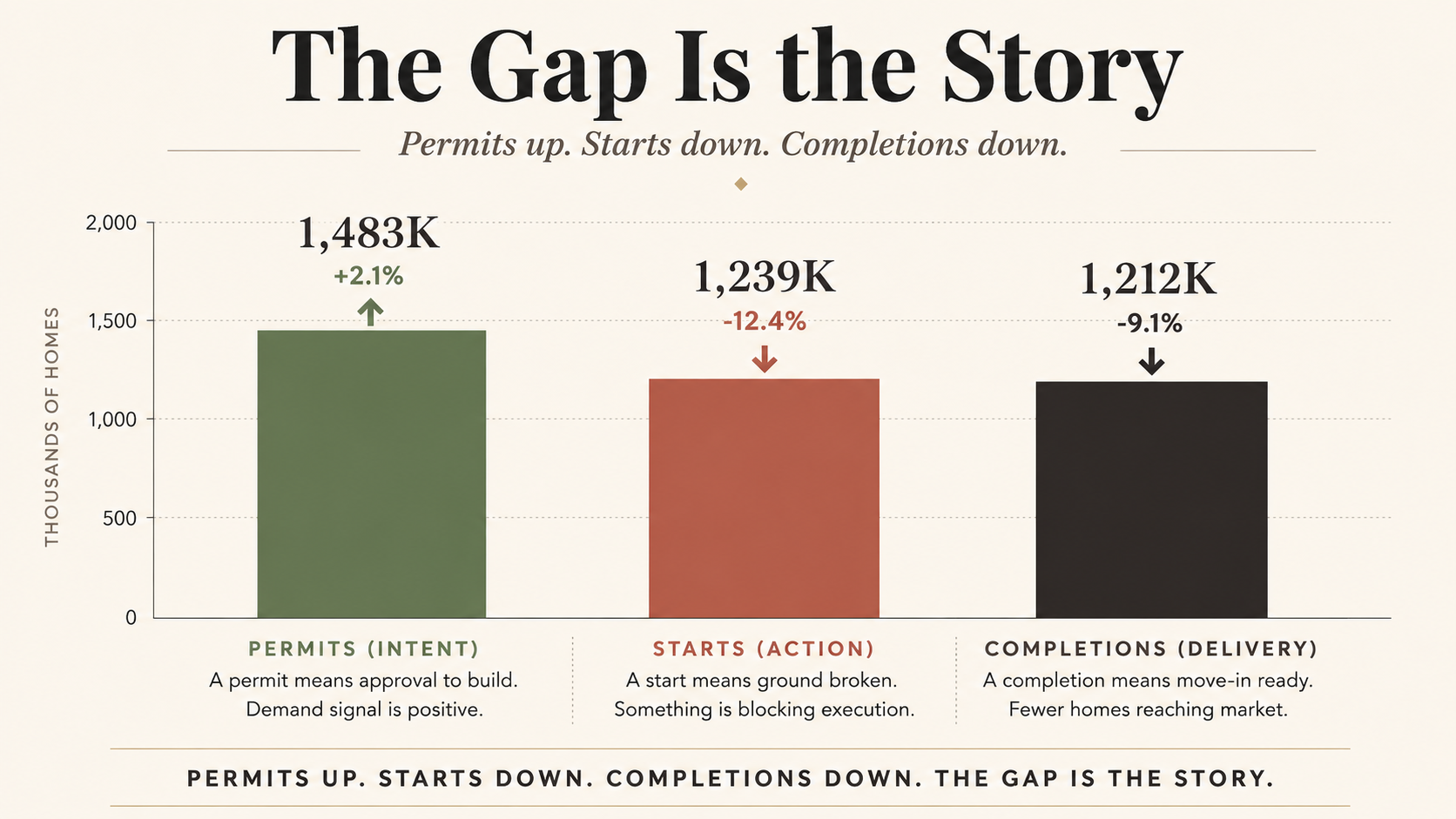
The July 2026 housing construction data tells three different stories depending on which number you read. Permits rose. Starts fell. Completions declined. Each metric measures a different stage of the housing pipeline, and the divergence between them is the most informative signal in the data.
Intent, Action, and Delivery Are Moving in Different Directions
Building permits (1,483,000 annualized, up 2.1%) represent intent. A permit means a builder has submitted plans, received local approval, and signaled willingness to build. Permits rising suggests that demand visibility is improving.
Housing starts (1,239,000 annualized, down 12.4%) represent action. A start means a builder has broken ground. Starts falling 12.4% in a single month means that despite having permits, builders are not moving forward. Something between the approval and the shovel is creating friction. Starts are also down 13.5% from July 2025.
Completions (1,212,000 annualized, down 9.1%) represent delivery. A completion means the home is finished and ready for someone to move in. Completions falling 9.1% monthly and 16.8% from a year ago means fewer homes are reaching the market. The pipeline is narrowing, not widening.
When permits rise but starts fall, it signals that builders see demand but face obstacles to acting on it. Those obstacles are specific and measurable.
Four Obstacles Between Approval and Construction
-
Lumber, labor, insurance, and land prices have not retreated enough to make marginal projects pencil. A builder may pull a permit when costs appear manageable, then delay breaking ground when updated bids come in higher than expected.
-
Construction loans at current rates add significant carrying cost. Some builders are waiting for rate clarity before committing capital to projects that will take 12 to 18 months to complete.
-
Even where permits are approved and financing is available, the physical capacity to build is limited by workforce availability. Skilled trade labor shortages continue to slow project timelines.
-
The 75% increase in insurance costs over five years has changed the economics of new construction, particularly in Sun Belt and coastal markets where IGC and many workforce housing operators focus.
Multifamily Is Pulling Back. Single-Family Is Holding.
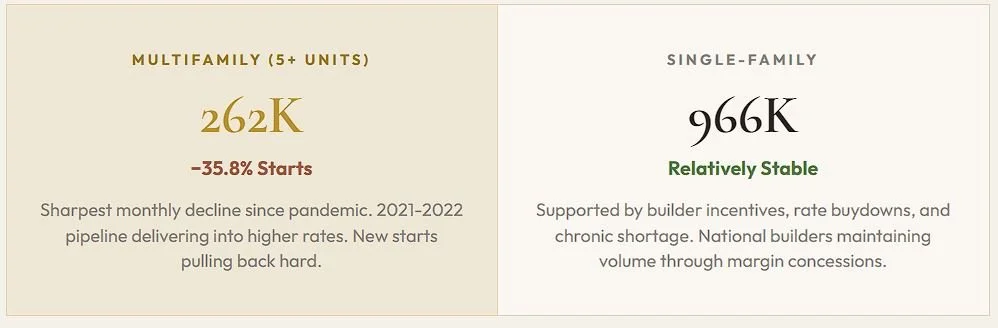
Multifamily starts fell 35.8%, the sharpest monthly decline since the pandemic. This reflects the development pipeline that was initiated during the low-rate era of 2021 and 2022 now encountering higher financing costs, tighter lender standards, and insurance headwinds. Single-family starts remained relatively stable, supported by builder incentives, rate buydowns, and the chronic shortage of entry-level homes.
The multifamily pullback is particularly significant for workforce housing. Fewer apartment starts today mean fewer available units 18 to 24 months from now. In markets already facing supply deficits, this contraction deepens the structural imbalance that drives occupancy and renewal rates for existing operators.
Fewer apartment starts today mean fewer available units 18 to 24 months from now. For existing workforce housing operators, the supply pipeline is narrowing in their favor.
The Supply Deficit Is Not Closing. It Is Widening.
The housing deficit was already estimated at 4.03 million homes. Falling starts and completions mean the pipeline is not closing that gap. In fact, it is likely widening it. Every month that completions decline below the formation rate of new households, the deficit grows.
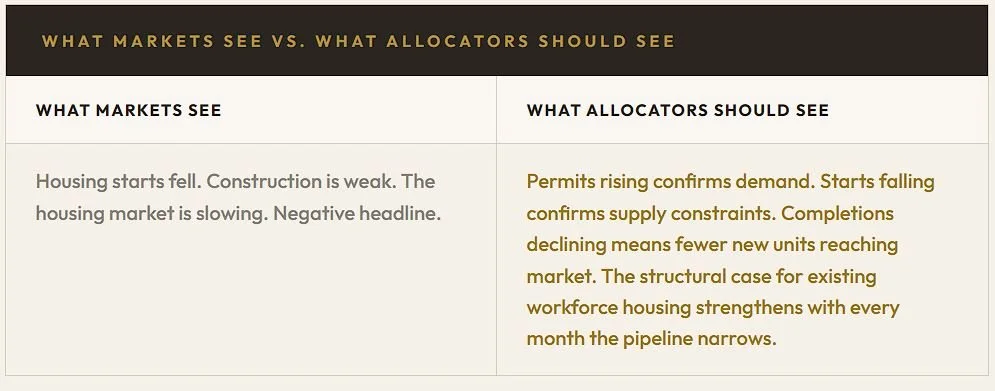
For allocators, this data reinforces the structural thesis for existing workforce housing. When new supply is constrained by costs, financing, labor, and insurance, existing well-located, stabilized assets with durable occupancy become more valuable. The alternative supply that would normally compete for tenants is not arriving fast enough to change the pricing dynamic.
Four Signals from the Construction Data
Permits rose to 1,483K but starts fell 12.4% to 1,239K and completions dropped 9.1% to 1,212K. The gap between intent and delivery is the housing story of 2026.
Four obstacles are blocking execution: elevated construction costs, expensive financing, constrained labor, and insurance costs that have risen 75% in five years. Each is structural, not cyclical.
Multifamily starts fell 35.8%, the sharpest monthly decline since the pandemic. Fewer apartment starts today mean fewer available units 18 to 24 months from now, deepening the supply deficit for renters.
The 4.03 million home deficit is not closing. It is widening. For existing workforce housing operators, every month the pipeline narrows strengthens occupancy, renewal rates, and the structural case for the asset class.
The Pipeline Is Narrowing in Our Favor
“Builders see demand. They are not building fast enough to meet it. For disciplined capital positioned in existing workforce housing, that gap is not a problem to solve. It is the thesis.”