

$28 Billion. 24 Hours. Zero Effect. What the Bond Market Just Told the Treasury.
Treasury doubled long-dated bond buybacks. Yields dropped immediately. Then the entire move reversed. For commercial real estate investors, the message is not about one trading day. It is about the rate regime itself.

Yesterday, the Treasury Department surprised the bond market. Today, the bond market surprised it back. Treasury Secretary Scott Bessent announced that Treasury would at least double buyback operations targeting 10-to-30-year bonds, taking the planned total from up to $14 billion to at least $28 billion. Long-term yields fell within minutes. By Thursday morning, the move had reversed.
Yields Fell Fast. Then the Market Reversed the Move.
On Wednesday, the 30-year Treasury yield dropped nearly 10 basis points within minutes, falling from 5.26% to 5.18%. The 10-year fell from 4.68% to 4.63%.
By Thursday morning, the entire move had reversed. The 30-year climbed back above 5.24%. The 10-year rose to 4.70%, above where it was before the announcement.
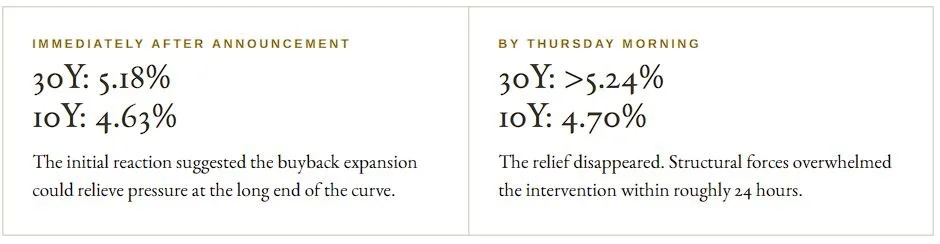
When Treasury tries to push yields down and the bond market pushes them back up within 24 hours, the signal is simple: underwrite to the rate environment that exists, not the one policymakers are trying to engineer.
A Treasury-Led Version of Operation Twist
Treasury is buying back older, less-liquid long-dated bonds and replacing them with new short-term bill issuance. If the strategy works, it can reduce pressure on long-term yields while shifting more government borrowing into shorter maturities.
TD Securities described the approach as a Treasury-led version of “Operation Twist,” the strategy the Federal Reserve used in 2011 to flatten the yield curve.
The Structural Forces Are Larger Than the Intervention
The timing was not accidental. The 30-year yield had reached its highest level since 2007. A recent 10-year auction carried the highest financing cost since 2007, while a 30-year auction produced the highest yield since 2001.
-
Record corporate debt issuance tied to the AI build-out is competing with Treasury issuance for investor demand. Global sovereign yields are also elevated.
-
Replacing long bonds with short bills may reduce long yields temporarily, but it makes the federal debt profile more sensitive to short-term rate changes.
-
Intervening more aggressively can itself raise risk premia if investors conclude Treasury sees current long-term yields as unsustainable.
JPMorgan’s Maia Crook summarized the problem directly: the interventions do not address the underlying structural challenges. A $28 billion buyback can change liquidity at the margin. It cannot change the fiscal, supply, inflation, and term-premium forces determining where long-term yields ultimately settle.
Treasury buybacks are not a substitute for the fiscal and monetary conditions that determine the long end of the curve.
The $40 Trillion Milestone Is a Rate Story, Not Just a Debt Story
$40T
O U T S TA N D I N G U . S . P U B L I C D E B T
The same day Treasury expanded the buyback program, outstanding public debt crossed $40 trillion for the first time. In January 2017, the national debt stood at just under $20 trillion. Nine years later, it had doubled.
The Floor Under Long-Term Yields May Be Rising Structurally
The federal government is now spending approximately $1.1 trillion per year servicing its debt. In the first ten months of fiscal year 2026, net interest payments reached $963 billion. These numbers matter because they affect the supply of bonds, the deficit, and the competition for capital across the economy.
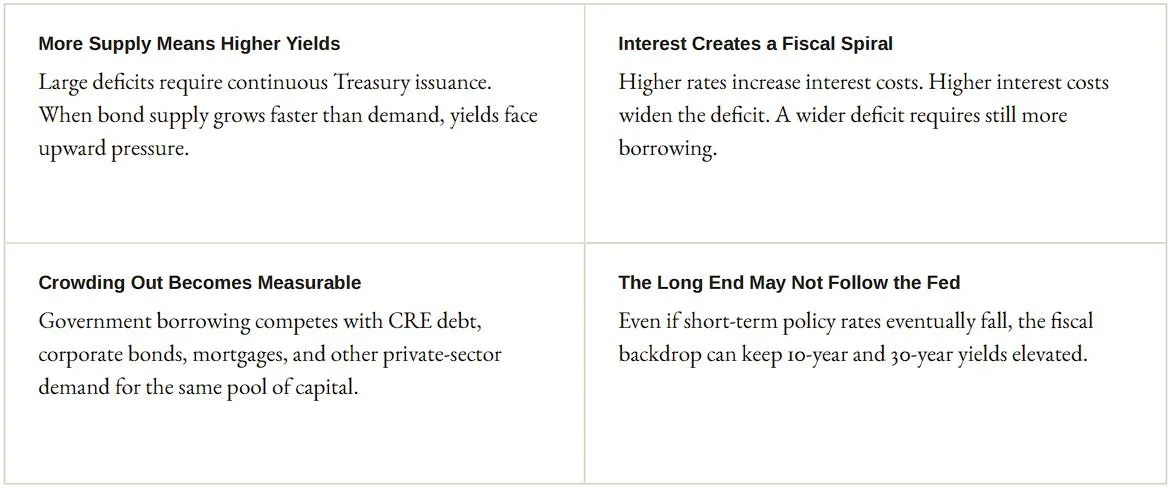
The low-rate environment of 2010-2021 should not automatically be treated as the baseline to which markets return. The fiscal trajectory has changed the structure of the rate environment.
The implication for allocators is straightforward: the cost of capital may remain structurally higher than many business plans assumed when assets were acquired or refinanced in the low-rate era.
CRE Must Underwrite to the Rate Regime That Exists
Treasury yields benchmark much of commercial real estate debt. Every basis point on the 10-year feeds into borrowing costs for commercial mortgage origination, CMBS pricing, and construction financing.
Refinancing math remains challenged
The $875 billion CRE maturity wall does not get easier with the 10-year near 4.70%. Borrowers that extended loans while expecting materially lower rates at refinancing still face difficult debt-service and proceeds math.
Cap rate compression remains difficult to underwrite
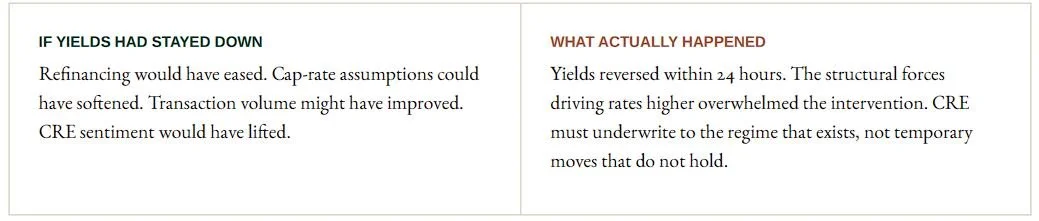
Valuations that depend on sustained yield declines require a durable change in the rate environment. A one-day rally that reverses the next morning does not change exit underwriting.
Observable income matters more when rate relief is uncertain
When borrowing costs stay elevated, assets that generate durable income independent of the next policy move become more attractive to disciplined capital. That is the structural case for stabilized workforce housing.
“For CRE investors, the lesson is not “rates can never fall.” It is that a durable underwriting thesis cannot
depend on policymakers successfully forcing long-term yields lower.”
Four Signals from the Bond Market
Treasury doubled buybacks to at least $28 billion targeting long-dated bonds. Yields dropped immediately, then reversed by Thursday morning. The intervention did not hold.
National debt crossed $40 trillion the same day. Net interest payments hit $963 billion in the first ten months of fiscal year 2026. The fiscal backdrop is working against sustained yield compression.
More aggressive intervention can create its own credibility problem. If markets believe Treasury is uncomfortable with current yields, investors may demand more compensation to hold long-duration debt.
For commercial real estate, the message is specific: do not underwrite to rate relief that may not arrive or may not hold. Focus on assets whose income thesis works through the rate environment that actually exists.
Underwrite to Conditions, Not Interventions
The Treasury tried to push yields down. The bond market pushed them back up within 24 hours. That does not settle the future path of rates, but it does show how difficult it is to overpower the structural forces shaping the long end of the curve.
“Do not underwrite to interventions. Underwrite to conditions. The assets that
perform through this regime are the ones that generate income the bond market
cannot take away.”