

Lenders Are Moving Faster Than Buyers. That Gap Is the Signal Most Investors Are Missing.
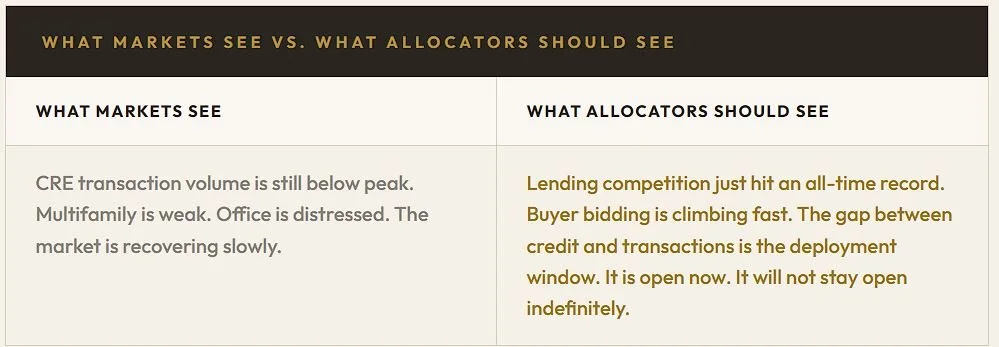
JLL's Credit Intensity Index hit 112, well above the previous 2021 record. Lending competition is the highest on record. But buyer bidding, while improving sharply, is still catching up. Credit is leading transactions. Historically, that pattern precedes the most significant deployment waves in commercial real estate.

Something is happening in real estate capital markets that deserves more attention than the headlines suggest. Lenders are competing for deals at the highest intensity on record. Buyers are coming back, but more slowly. And the gap between those two lines may be the most important leading indicator in commercial real estate right now.
Understanding why matters more than knowing that it is happening. Because the divergence between credit and transactions has historically preceded the most significant deployment waves in CRE. And knowing how to read it separates the allocators who position ahead of the wave from those who react to it.
Credit Leads. Transactions Follow.
JLL publishes two proprietary indexes drawn from nearly $9 trillion in investment sales bids and loan quotes. The Credit Intensity Index tracks how aggressively lenders are competing to place capital. The Bid Intensity Index tracks how actively buyers are bidding on properties. Together, they show whether the money wants to lend faster than investors want to buy, or the reverse.
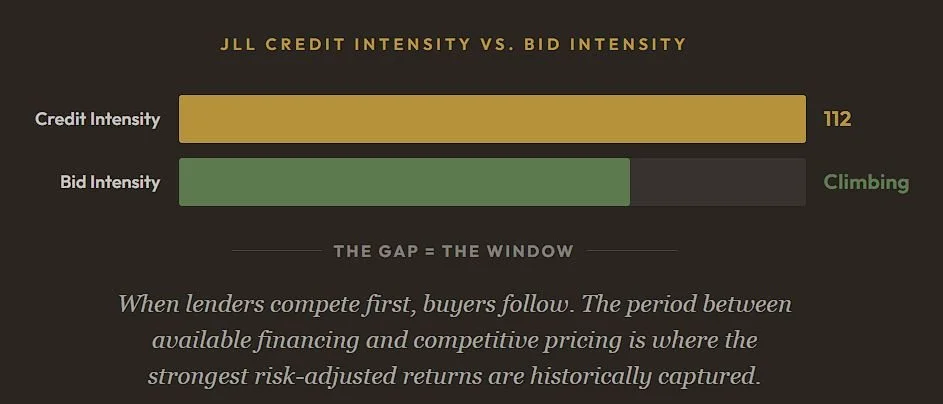
Source: JLL Global Bid Intensity Index and Credit Intensity Index, August 25, 2026.
Right now, the Credit Intensity Index stands at 112, well above the previous record set in 2021. Banks, CMBS lenders, insurance companies, government agencies, and debt funds are all active and competing to deploy simultaneously. The Bid Intensity Index is climbing but remains below the credit line. June posted the sharpest monthly improvement in a year. July recorded the second-highest unique bidder count since JLL began tracking five years ago.
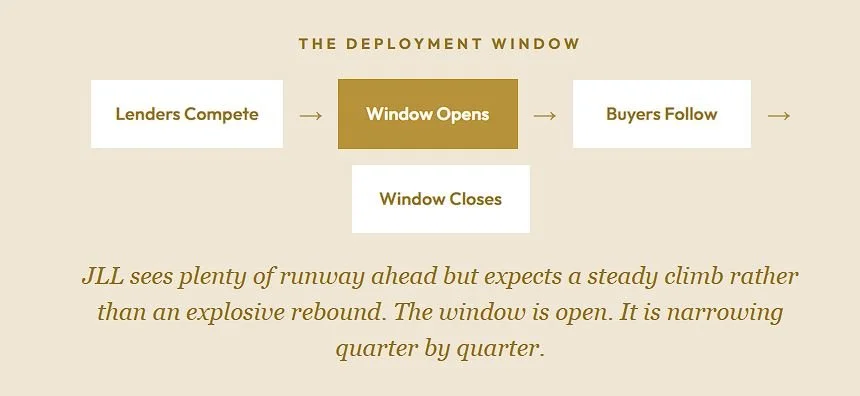
When lenders are competing harder than buyers, it means financing is available before demand fully materializes. That creates a window: the period between when capital becomes accessible and when competition pushes pricing higher.
Liquidity Is Not Flowing Evenly. That Selectivity Is the Second Signal.
-
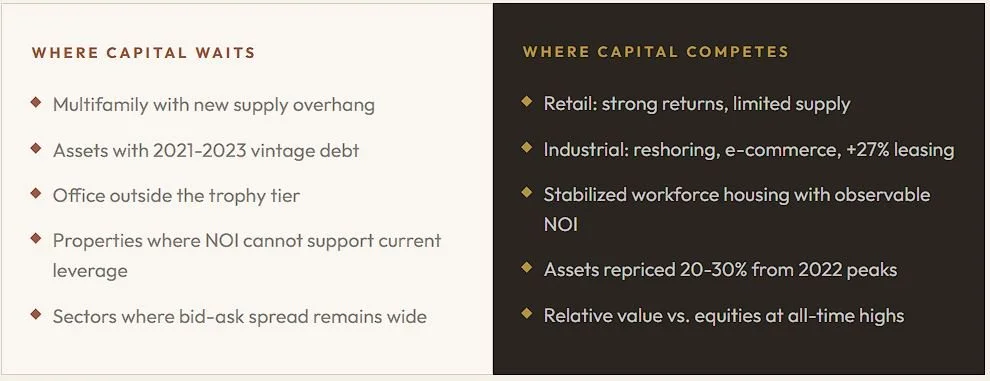
Owners are enjoying strong returns with limited incentive to sell. Renewed demand against constrained supply is tightening the bidding environment. Necessity-based retail, grocery-anchored centers, and experiential properties are the focus.
-
E-commerce, reshoring, and reindustrialization continue driving demand. CBRE reported manufacturing leasing rose 27% year over year as companies move production closer to the U.S. to strengthen supply chains and reduce tariff exposure. Large warehouse vacancy rates are declining.
-
The market is absorbing a historic construction pipeline. CoStar found stabilized multifamily vacancies rose 34 basis points in Q2. National vacancies are improving but new supply is suppressing rent growth and keeping capital cautious.
-
The new supply wave pressuring Class A luxury apartments is not pressuring Class B workforce housing, where tenants renew because they have no better alternative. Stabilized workforce housing with observable NOI occupies a distinct position within a sector the market is treating as uniformly weak.
Repriced Assets. Record Lending. A Defined Window.
CRE values have repriced significantly since 2022. JLL notes that commercial real estate is at what it considers an attractive entry point relative to equities near all-time highs. That repricing, combined with record lending competition, creates a specific setup: assets that were too expensive three years ago are now available at better basis with better financing terms than at any point since 2021.
But the window is defined by the divergence. When buyer bidding catches up to lender competition, the gap closes. Pricing tightens. Competition intensifies. The favorable terms that lenders are offering today to win business become less favorable as more buyers enter the market.
Deployed Before the Bidding Catches Up
At IGC, we are positioned in the asset class where structural demand is strongest and new supply pressure is lowest: stabilized workforce housing in supply-constrained markets. The multifamily new supply wave is pressuring Class A luxury apartments. It is not pressuring Class B workforce housing where tenants renew because they have no better alternative.
Credit leads transactions. We intend to be deployed before the bidding catches up.
Four Signals from the Capital Markets
JLL's Credit Intensity Index hit 112, above the 2021 record. Banks, CMBS, insurers, agencies, and debt funds are all competing to deploy simultaneously. Lending competition is the highest ever recorded.
Buyer bidding posted its strongest monthly improvement in a year in June. July had the second-highest unique bidder count in five years. But bidding still trails lending intensity. Credit is leading transactions.
Capital is not flowing evenly. Retail and industrial are drawing the most competitive bidding. Multifamily is the weakest sector as it absorbs new supply. Within multifamily, stabilized workforce housing occupies a structurally different position.
The divergence between lender competition and buyer bidding defines the current window. When the gap closes, pricing tightens and favorable terms erode. The window is open. It will not stay open indefinitely.
The Window Between Financing and Competition
“Do not underwrite to interventions. Underwrite to conditions. The assets that
perform through this regime are the ones that generate income the bond market
cannot take away.”