

Institutional Capital Is Moving Down-Market. What Happens When Wall Street Starts Competing for Main Street Real Estate?
KKR just published research identifying a $5.1 trillion middle-market real estate opportunity: 5,800 sponsors managing 300,000 properties. To reach them, KKR closed a $6.2 billion fund, the largest first-time fund in the GP solutions space. The question is not what KKR sees. It is what that tells you about where returns are getting harder to find.

When a firm managing $758 billion in assets builds an entirely new platform to serve sponsors managing $50 million to $500 million, it is not because they ran out of large deals to do. It is because the math at the top of the market has changed.
KKR's Arctos Keystone research, published this month, quantified something that allocators have been sensing: the real estate market's center of gravity is not at the top. It is in the middle. And institutional capital is beginning to follow.
5,800 Sponsors. 300,000 Properties. 85% of Institutional CRE.
Arctos defines a middle-market sponsor as any firm managing at least 25 properties with less than $1.5 billion in dry powder. Large-cap sponsors are the publicly traded multistrategy groups above that threshold. Only 27 firms qualify. The remaining 5,800 are the middle market.
These are not individual landlords or mom-and-pop operators. These are institutional-quality sponsors running professional portfolios across every major commercial real estate asset class.
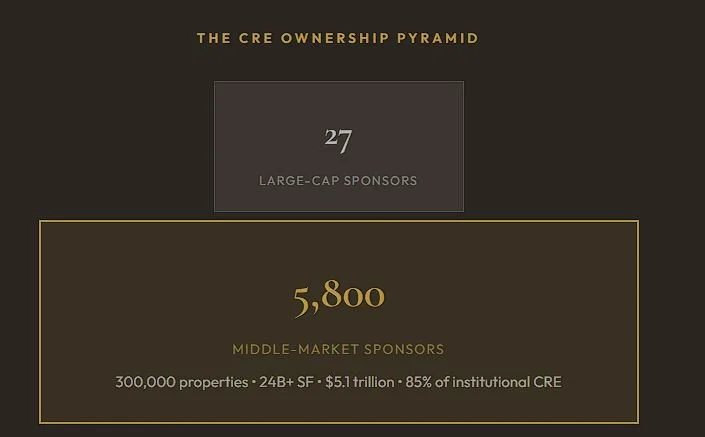
Source: KKR/Arctos analysis utilizing CoStar and Preqin data, January 2026.
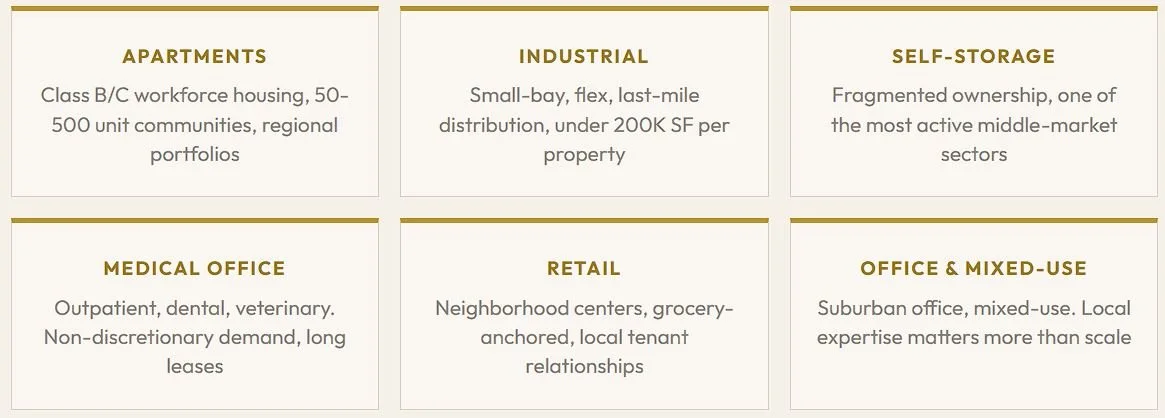
It Does Not Buy Properties. It Invests in the Sponsors Who Own Them.
In July 2026, Arctos closed its inaugural Keystone Partners Fund I at $6.2 billion in capital commitments, exceeding its $4 billion target. The investors include some of the largest pension funds, retirement systems, endowments, insurance companies, family offices, and global wealth platforms.
-
Equity investment to help sponsors scale their platforms, hire talent, build infrastructure, and pursue acquisitions they could not finance independently.
-
Capital to allow sponsors to meet their own co-investment obligations across multiple funds and deals without overextending personal balance sheets.
-
Solutions for sponsors who need to restructure equity among partners, buy out retiring founders, or transition ownership to the next generation.
-
Capital to refinance or restructure existing portfolios, particularly for the 2,500 sponsors formed between 2010 and 2019 who built portfolios in a low-rate environment and now face a different capital landscape.
69% of middle-market real estate sits outside traditional closed-end fund structures, in joint ventures, syndications, programmatic partnerships, and deal-by-deal relationships. That fragmentation is the gap institutional capital is now designed to fill.
Returns at the Top Are Compressing. The Middle Is Where the Math Works.
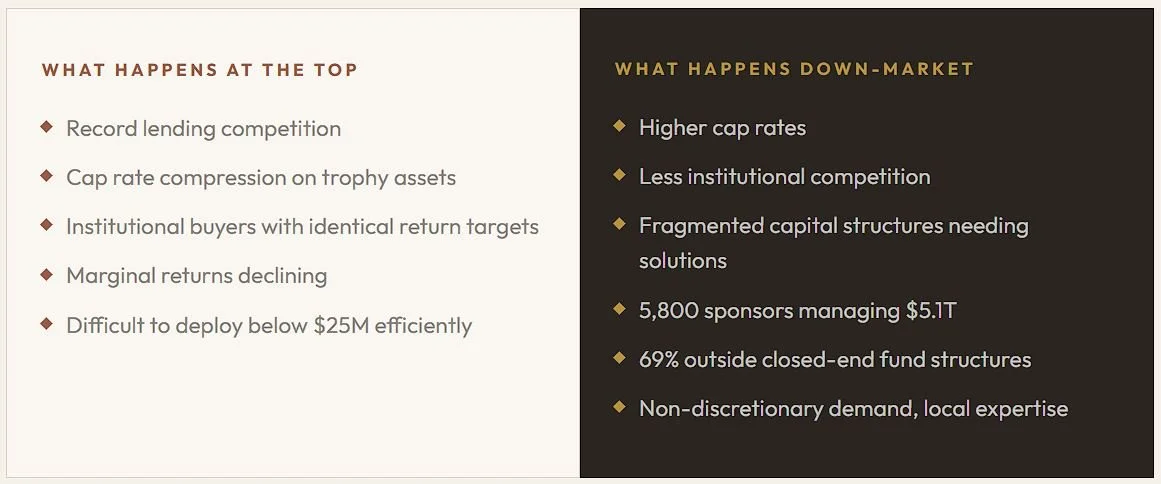
Large-cap CRE is the most efficiently priced segment. Institutional buyers compete with similar cost of capital, underwriting models, and return targets. When cap rates tighten on trophy assets, the marginal return on the next large-cap deal diminishes. Capital seeks better risk-adjusted opportunities further down.
Large institutions cannot deploy efficiently below $25 million. Assets below that threshold end up raising from the retail channel, family offices, and regional insurers. That creates a structural gap where institutional-quality assets are owned by institutional-quality sponsors but financed with sub-institutional capital.
The post-GFC generation is hitting a maturity wall. The 2,500 sponsors formed between 2010 and 2019 built portfolios in a low-rate environment. Many now manage assets financed at rates that no longer exist. That creates both distress and opportunity depending on the operator.
Institutional Migration Validates the Thesis
For investors already positioned in middle-market real estate, the institutional migration creates a dual dynamic. More institutional capital means more competition and potentially tighter pricing over time. The moat that smaller operators enjoyed by being present where large institutions did not look is beginning to erode.
But institutional migration validates the thesis. When KKR closes a $6.2 billion fund to serve middle-market sponsors, it confirms that the returns, the demand, and the structural opportunity are real and durable. For allocators who arrived early, institutional interest adds liquidity, credibility, and exit options that did not exist when the market was overlooked.
“The key distinction is whether you are the operator being served by institutional capital or the allocator competing against it. Those two positions produce very different outcomes from the same structural shift.”
We Have Always Operated in the Middle Market
At IGC, we have always operated in the middle market. Not because we could not access larger deals, but because the middle market is where the structural advantages live: higher cap rates, non-discretionary demand, local operating expertise, and assets that serve communities rather than institutions.
Our workforce housing portfolio consists of exactly the asset type these 5,800 sponsors manage: Class B multifamily in supply-constrained markets where tenants renew because they have no better alternative. These are 50 to 300 unit communities, not 500-unit luxury towers. The demand is local. The income is observable. The capital structures are conservative.
When the largest firms in private equity start building $6.2 billion platforms to reach the markets we already serve, it does not change our strategy. It validates our timing.
Four Signals from the Institutional Migration
Middle-market sponsors manage apartments, industrial, retail, self-storage, and medical office across 300,000 properties and 24B+ square feet. This is 85% of institutionally sponsored commercial real estate. It is the market's center of gravity.
Arctos Keystone Partners Fund I closed at $6.2B, the largest first-time GP solutions fund ever. It provides growth capital, GP funding, recapitalization, and platform support. It does not buy properties. It invests in the sponsors who own them.
69% of middle-market real estate sits outside closed-end fund structures. Large institutions cannot deploy efficiently below $25M. That fragmentation creates the structural gap institutional capital is now designed to fill.
For allocators already in the middle market, institutional migration validates the thesis and adds liquidity. The question is no longer whether this segment is investable. It is who has the positioning to capture it before competition intensifies.
They Did Not Need KKR's Research to Confirm the Thesis
“When KKR raises $6.2 billion to serve middle-market real estate sponsors, it tells you two things: returns at the top are compressing, and the structural opportunity in the middle is real enough to justify institutional infrastructure. The allocators who were already positioned did not need the research. But the migration that follows it will determine whether they captured the opportunity ahead of the competition or alongside it.”