

The Apartment Pipeline Is Shifting. The Markets Getting the Most New Supply Are Not the Ones You Would Expect.
Durham led the nation in multifamily permitting intensity at 45.2 units per 10,000 residents, 56% above second place. Seven of eight most permit-intensive markets have populations below 1.5 million. The construction pipeline is concentrating in smaller, fast-growing metros. For workforce housing allocators, the supply map just changed.
New Census Bureau permitting data for the first half of 2026 reveals a pattern that should reshape how allocators think about multifamily supply risk. The construction pipeline is not concentrating where most investors expect. It is concentrating in the smaller, fast-growing metros where population growth is strongest, development costs are lower, and the regulatory environment is more permissive.
Smaller Metros Are Leading. The Carolinas Are the Epicenter.
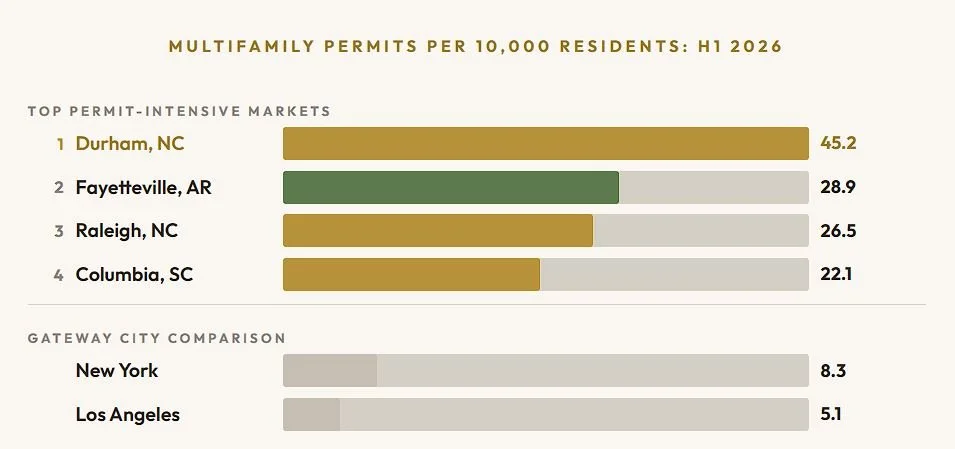
Source: U.S. Census Bureau, Arbor Realty Trust/Chandan Economics. H1 2026 multifamily permits (5+ unit buildings) per 10,000 metro residents.
The pattern is unmistakable: seven of the eight most permit-intensive markets had populations below 1.5 million. The Carolinas are the epicenter. Durham, Raleigh, Columbia, and Charlotte all ranked among the top 12 nationally. South Carolina grew 1.5% in 2025, the fastest rate nationally. North Carolina ranked third at 1.3%. Developers are following the people.
Columbia Posted a 468% Year-Over-Year Surge
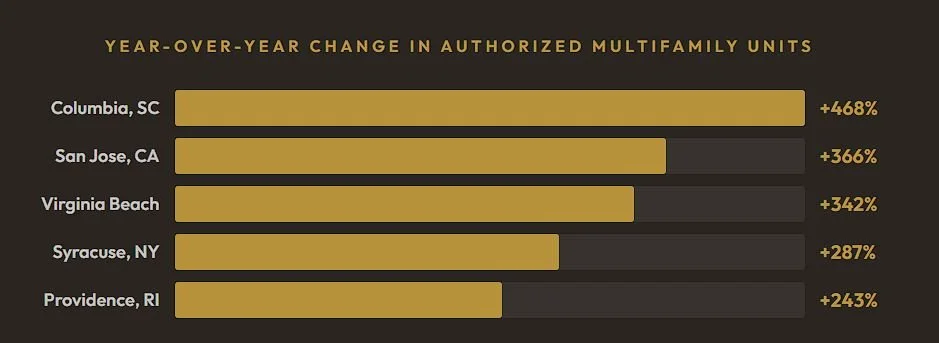
Source: U.S. Census Bureau. H1 2025 vs H1 2026, authorized multifamily units (5+ buildings).
A regional split is emerging. The Northeast showed the broadest improvement, with 12 of its 16 top-100 metros permitting more units than a year earlier. The Midwest also gained ground. Most Southern metros declined, but the Carolinas were the notable exception, accounting for six of the South's 14 markets with year-over-year growth.
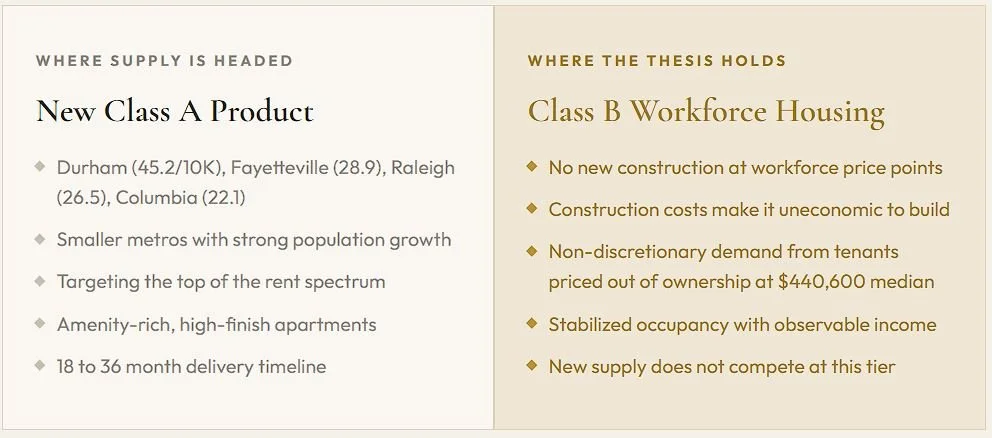
The permitting data tells you where supply is heading over the next 18 to 36 months. Permits are approved today. Construction takes 12 to 24 months. Delivery follows. The markets showing the sharpest acceleration are the markets where new supply will compete with existing assets in 2028 and 2029.
New Supply Is Targeting Class A, Not Class B
The permits being pulled in Durham, Raleigh, and Columbia are overwhelmingly for new Class A product: amenity-rich, high-finish apartments at the top of the rent spectrum. Class B workforce housing, the segment IGC operates in, is not being built at scale because construction costs make it uneconomic to deliver new workforce-priced product.
“Capital follows population. Supply follows capital. But the supply being built does not serve the tenant who earns $45,000 and needs a two-bedroom at $1,200. That tenant is the IGC thesis. And today’s permitting data shows that nobody is building for them.”
Gateway city supply pressure is easing. New York at 8.3 and Los Angeles at 5.1 permits per 10,000 residents are permitting at a fraction of the rate of smaller metros. For investors in gateway city workforce housing, the supply headwind may actually be lighter than in the high-growth secondary markets.
The lag matters more than the headline. If units are not under construction, they are not delivering next year. Permits are a leading indicator, but the delivery timeline means current occupancy and rent dynamics have 18 to 24 months of runway before new supply arrives. Investors in stabilized assets have time, but they need to be watching the pipeline market by market.
Four Signals from the Permitting Data
-
Seven of the eight most permit-intensive markets have populations below 1.5 million. Durham leads at 45.2 units per 10K residents. The construction pipeline is concentrating in smaller, fast-growing metros, not gateway cities.
-
The Carolinas are the epicenter: Durham, Raleigh, Columbia, and Charlotte all rank in the top 12 nationally. South Carolina grew 1.5% in 2025 (fastest nationally), North Carolina at 1.3% (third). Developers are following the people.
-
Columbia posted +468% year over year, the largest permitting acceleration in the country. But the permits are overwhelmingly for Class A product. Class B workforce housing is not being built at scale because construction costs make it uneconomic at workforce price points.
-
For investors in stabilized workforce housing, the supply headwind is lighter than the headline suggests. New supply targets a different tenant, a different price point, and a different product type. The structural gap between what is being built and what the workforce needs is the thesis.
Nobody Is Building for the Workforce Tenant
“The apartment pipeline is shifting toward smaller, fast-growing metros where population is arriving fastest. That tells you where supply is heading in 2028 and 2029. It does not tell you where workforce housing tenants are losing alternatives. Nobody is building for them. That gap is the thesis.”