

J.P. Morgan Targeted $500 Million. Investors Gave Them $1.1 Billion. The Market Is Telling You Where Cash Flow Lives Now.
The same week, BDC portfolios showed $2.3 billion in unrealized losses and 81% of software loans marked down. One side of the market faces redemptions. The other is oversubscribed at 2x. Capital is not disappearing. It is rotating from uncertain yield toward observable, contracted income.
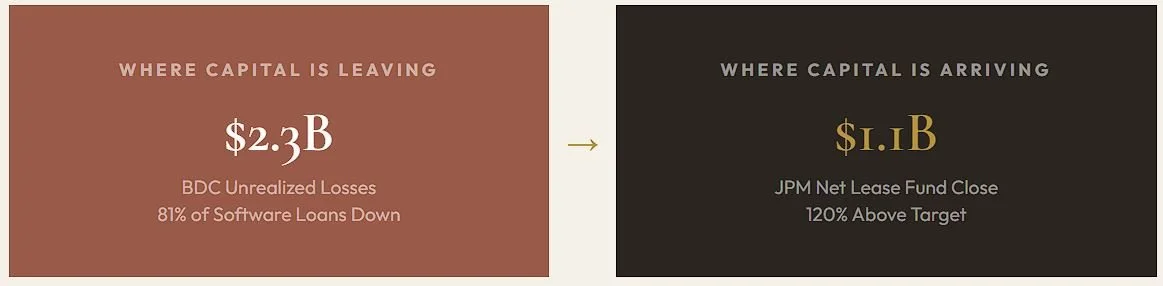
When a fund targets $500 million and closes at $1.1 billion, the oversubscription is not the story. The story is what it tells you about where institutional capital wants to be right now. Read that against BDC portfolios showing 81% of software loans marked down and $4.3 billion in redemption requests. In the same cycle, one side of the market is under redemption pressure and the other is being oversubscribed at 2x. That divergence is not random. It is a rotation.
$500M Target. $1.1B Close. Over Half the Investors Were New.
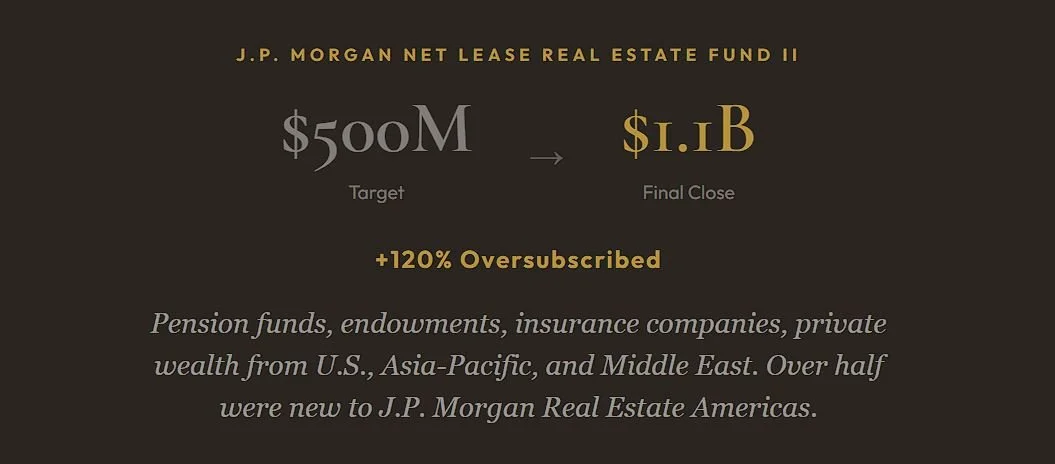
The fund targets single-tenant industrial properties and industrial outdoor storage assets with long-term triple-net leases. In a triple-net lease, the tenant pays property taxes, insurance, and maintenance. The landlord collects rent. The cash flow is contractual, predictable, and largely insulated from operating cost volatility.
Onshoring and manufacturing growth are the demand drivers. U.S. manufacturing leasing rose 27% year over year as companies move production closer to domestic markets. Sale-leaseback activity is accelerating as companies seek capital without relinquishing operational control. J.P. Morgan's banking relationships give the fund sourcing advantages that most net lease buyers cannot replicate.
“Net lease is increasingly becoming a cash-flow play rather than an interest-rate play. When the 10-year is at 4.97% and the path of rates is uncertain, assets that deliver contracted, long-duration income regardless of where yields settle become the most defensible positions in a portfolio.”
Record Deal Count. 64% Above the Pre-Pandemic Average.
Marcus & Millichap data shows single-tenant retail transaction activity jumped more than 23% in 2025 and continued climbing through mid-2026. For the 12 months ended June, deal count reached a record while dollar volume ranked second only to 2022. Transaction volume now stands 64% above the 2014 to 2019 annual average. Private investors accounted for 73% of single-tenant retail dollar volume.
Contractual Certainty and Structural Certainty Answer the Same Question
The rotation toward contracted, observable income is not limited to net lease industrial. It is the same thesis driving workforce housing.
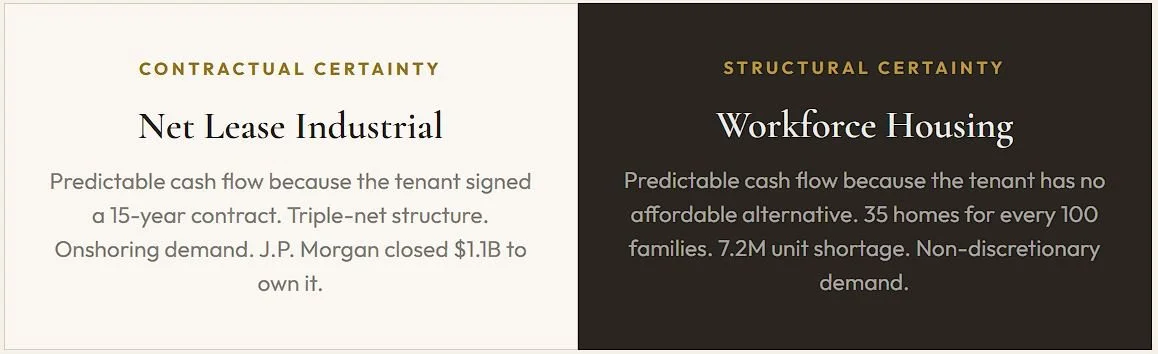
“Both answer the same allocator question: does this asset generate income I can observe and underwrite regardless of where rates, sentiment, or credit conditions move?”
Four Signals from the Rotation
-
J.P. Morgan closed its net lease fund at $1.1B, 120% above its $500M target. Over half the investors were new to the platform. Anchored by pension funds, endowments, and insurers from the U.S., Asia-Pacific, and Middle East.
-
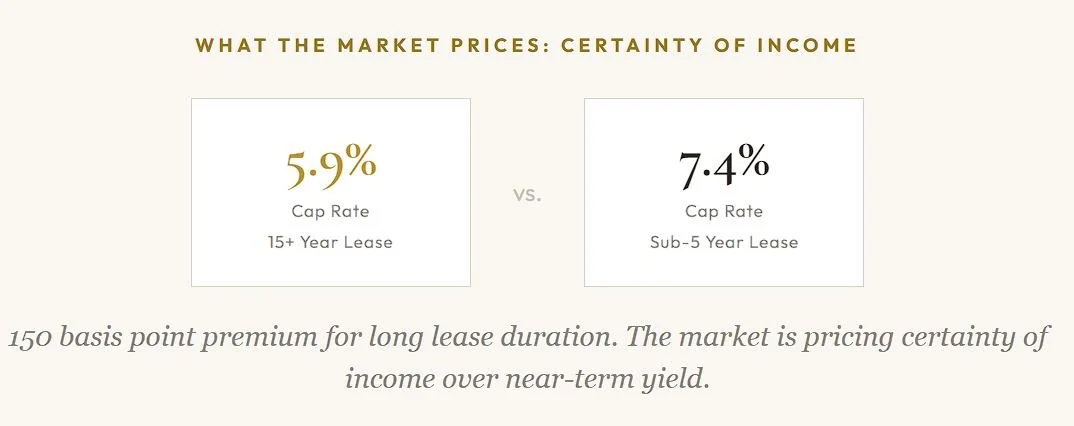
Net lease transaction volume is 64% above the 2014 to 2019 average. Deal count at a record. Assets with 15+ year leases cap at 5.9% versus 7.4% for sub-5 year. Certainty of income commands a 150 basis point premium.
-
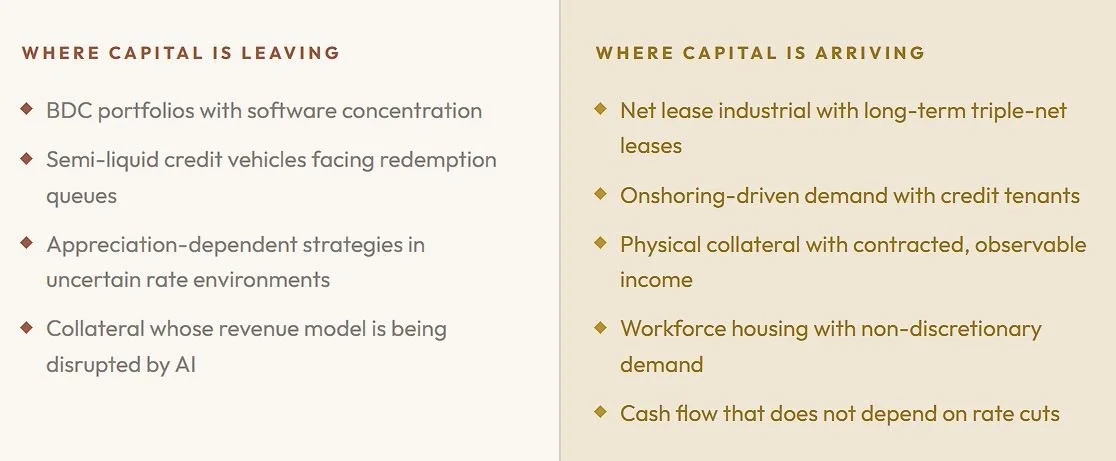
The same week: BDC portfolios showed $2.3B in losses and 81% of software loans marked down. One side of the market faces redemptions. The other is oversubscribed at 2x. The divergence is a rotation toward observable, contracted cash flow.
-
The thesis applies equally to net lease industrial and workforce housing. One produces income through contractual certainty. The other through structural certainty. Both answer the same question: does this asset generate income regardless of where rates or sentiment move?
The Advantage Belongs to Assets with Income You Can See
“Capital is not disappearing. It is rotating. Away from uncertain yield and toward observable, contracted income. The market is telling you where cash flow lives now. The advantage belongs to assets with income you can see.”