

The First Trillion-Dollar Ecosystem? Wall Street Is Not Valuing SpaceX as a Rocket Company.
The market is pricing a vertically integrated infrastructure ecosystem where launch, connectivity, AI, and platform ownership reinforce one another.
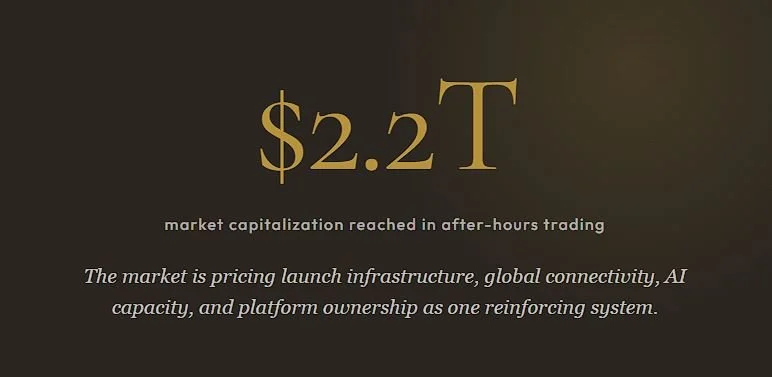
SpaceX completed the largest initial public offering in stock market history today. Shares priced at $135, opened at $150, traded as high as $176.52, and closed at $160.95, up 19%. More than 500 million shares changed hands. In after-hours trading, the stock moved higher again, pushing the market capitalization past $2.2 trillion.
The first-day pop is not the story. The more important story is what the $75 billion raise, the $2.2 trillion market capitalization, and the S-1 filing reveal about how Wall Street is valuing the company. The market is not treating SpaceX as a rocket maker. It is treating SpaceX as a vertically integrated infrastructure ecosystem.
What Wall Street Is Really Pricing
Consider what now sits under the SpaceX umbrella. Starlink provides global internet connectivity to more than 10 million subscribers across 164 countries. SpaceX controls launch infrastructure with a global market share that competitors have not replicated at scale. xAI adds artificial intelligence capabilities and data center demand. Starship, still in development, adds optionality around orbital compute, lunar cargo, and point-to-point transport.
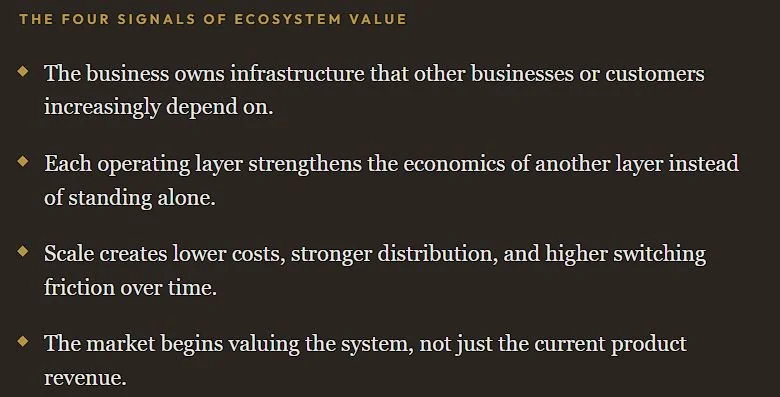
Individually, each business would matter. Together, they create something more powerful: a network of businesses that reinforce one another. Launch infrastructure expands the satellite network. Starlink converts that network into recurring revenue. AI creates new applications and demand for compute capacity. Each layer strengthens the other layers.
The SpaceX Ecosystem Stack
-
Access to orbit at scale, with cost structure and cadence that competitors struggle to match.
-
A recurring revenue network that monetizes launch capability through global broadband demand.
-
Applications and data center capacity that create new demand for connectivity, power, and infrastructure.
-
A system where the value of the whole can exceed the value of the separate parts.
“The market is not pricing a rocket company. It is pricing the possibility that launch, connectivity, AI, and orbital infrastructure can compound as one system.”
Why the Premium Exists
Morningstar has estimated that Starlink alone, using typical broadband infrastructure multiples, could be worth hundreds of billions of dollars. Other institutional holders value SpaceX below the IPO-implied level, creating a gap between traditional sum-of-parts analysis and what the public market appears willing to pay.
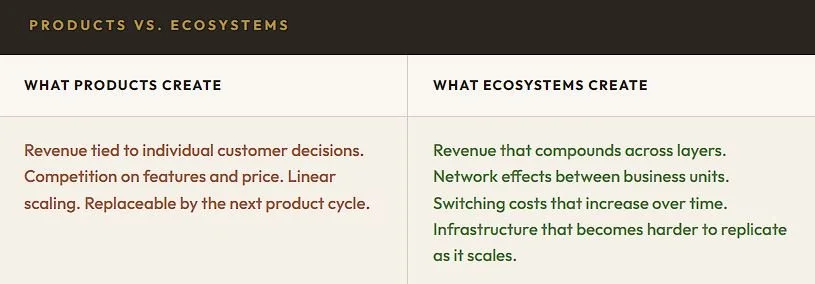
That premium is a bet on ecosystem compounding. It is the thesis that the whole can be worth substantially more than the pieces because each piece strengthens the rest of the network. In a traditional product company, growth is often tied to unit sales, customer adoption, or feature cycles. In an ecosystem, growth can compound across layers.
Why Ecosystems Compound Differently
This is how many of history's most valuable businesses were built. Railroads were not simply transportation companies. They became economic ecosystems that controlled land, logistics, communications, and commerce along their routes. Cloud providers were not simply software companies. They became digital infrastructure platforms where compute, storage, security, and AI reinforced one another.
The distinction matters because platforms compound differently from products. Competitors can replicate products. Replicating an ecosystem is much harder. A system where launch costs subsidize satellite deployment, satellite revenue funds new infrastructure, and AI demand increases the need for compute and connectivity is not a single product line. It is a compounding architecture.
The Ecosystem Bet Is Not Risk-Free
The valuation question is not simple. The S-1 also reveals the pressure inside the model. SpaceX posted a GAAP net loss in 2025. xAI generated large losses. The company carries a significant accumulated deficit. Starlink is effectively subsidizing the rest of the ecosystem while the next layers mature.
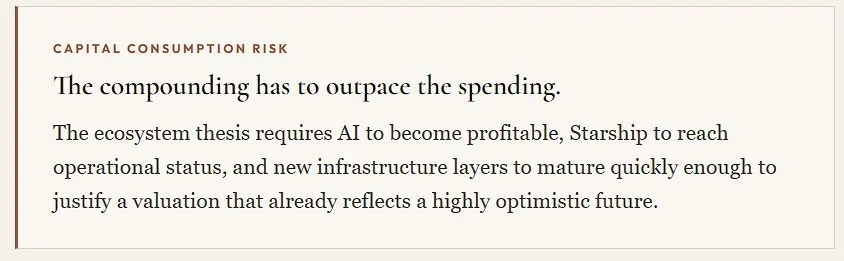
That may prove correct. But allocators should see it clearly for what it is: a bet on ecosystem compounding at a price that already assumes the system works. The lesson is not that every infrastructure platform deserves any valuation. The lesson is that infrastructure ownership can command a different kind of market logic when the layers truly reinforce one another.
The Enduring Question for Allocators
Whether the after-hours valuation is justified is a question for public equity analysts. The more enduring question for capital allocators is structural: who controls the underlying infrastructure that the next economy depends on?
Whether the future is artificial intelligence, advanced communications, autonomous systems, or space-based infrastructure, the question remains consistent: who owns the foundation beneath it? Over long periods, markets often reward innovation. But they tend to reward ownership even more.
At IGC, that principle drives our barbell. On one side, workforce housing is infrastructure that the economy depends on: essential, non-discretionary, and impossible to replicate digitally. On the other side, our Brightstead Technology partnership captures the digital infrastructure layer where compute, connectivity, and power are becoming the binding constraints.
The next generation of market leaders may not be the companies with the best individual products. They may be the companies that own entire ecosystems.
Four Principles From the SpaceX Valuation
The market is not pricing SpaceX as a rocket company. It is pricing a vertically integrated ecosystem where launch, connectivity, AI, and orbital infrastructure reinforce one another.
Starlink is the profit engine because it turns launch capability into recurring subscription-style revenue and helps fund the rest of the system.
The ecosystem thesis has real risks. The compounding must eventually outpace capital consumption, and that outcome is not guaranteed.
The enduring investment principle is infrastructure ownership. Durable wealth is often created by owning the foundation that growing industries depend on.
Markets Reward Innovation. Over Time, They Reward Ownership More.
The SpaceX IPO may be remembered for its size, its first-day trading, and its extraordinary implied valuation. But the structural lesson is more important than any single trade. The most valuable businesses eventually stop selling products and start owning ecosystems.
“Markets reward innovation. Over time, they reward ownership more.”