

When Capital Moves, Who Benefits? The Next Migration of Wealth May Already Be Underway.
New York just signed a tax on luxury second homes. Capital rarely disappears. It moves. IRS data shows $9.9 billion left New York in a single year. $20.6 billion landed in Florida. For allocators, the question is not the tax. It is where the capital goes next and what it creates when it arrives.
Governor Hochul signed the New York state budget, which includes a new progressive surcharge on luxury second homes in New York City. The tax applies to non primary residences valued at $5 million or more and takes effect July 1. It is expected to generate approximately $500 million annually and will affect roughly 10,000 properties citywide.
We are not here to argue whether this is good policy. That is a political question, and this is a capital allocation publication. What we are here to examine is the investment question: when tax policy changes incentives for how and where wealthy individuals deploy capital, where does that capital go? And what opportunities does its arrival create?
History answers this question clearly: capital rarely disappears. It moves.
The IRS Data Is Unambiguous
The IRS publishes annual data on adjusted gross income migration between states. The most recent data confirms what has been building for years: capital is flowing out of high tax jurisdictions and into states that compete for it.
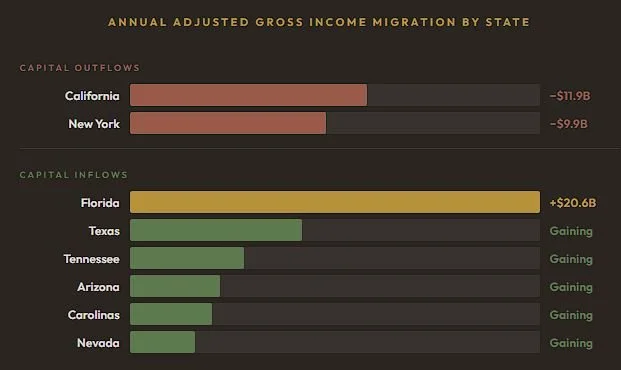
Source: IRS Statistics of Income, state-to-state income migration data. Annual adjusted gross income flows.
California lost $11.9 billion and New York lost $9.9 billion in adjusted gross income in a single year. Florida gained $20.6 billion. Texas, Tennessee, Arizona, Nevada, and the Carolinas all posted meaningful net inflows. This is not random migration. This is capital responding to incentives.
The story is not about any single tax. It is about a structural shift in how states compete for capital. And the states that are winning that competition are creating the next generation of investment opportunities in housing, infrastructure, and real assets.
Five Corridors Absorbing the Migration
Capital migration does not distribute evenly. It concentrates in markets that offer a specific combination of tax advantage, economic infrastructure, quality of life, and capacity for growth.
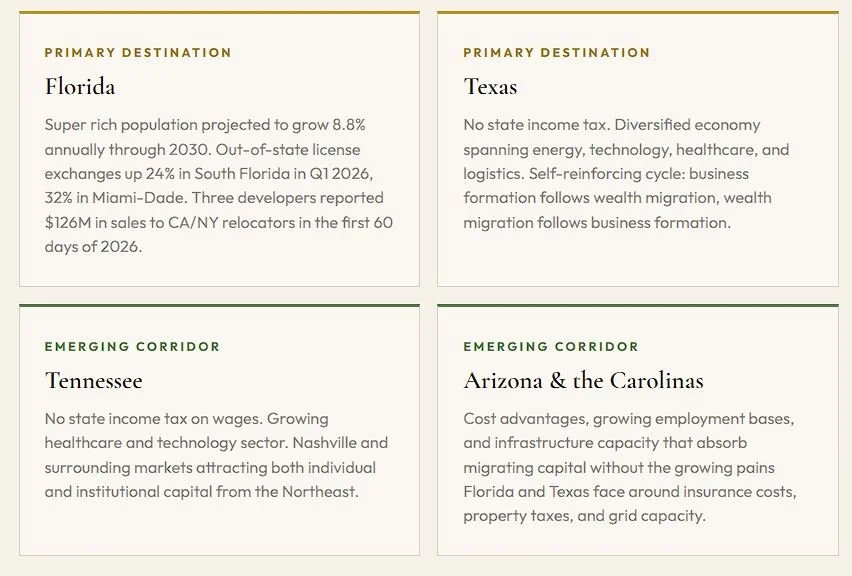
For allocators, the question is not just which states are gaining population. It is which markets within those states have the infrastructure, housing capacity, and economic base to absorb the capital productively.
What Capital Migration Actually Creates
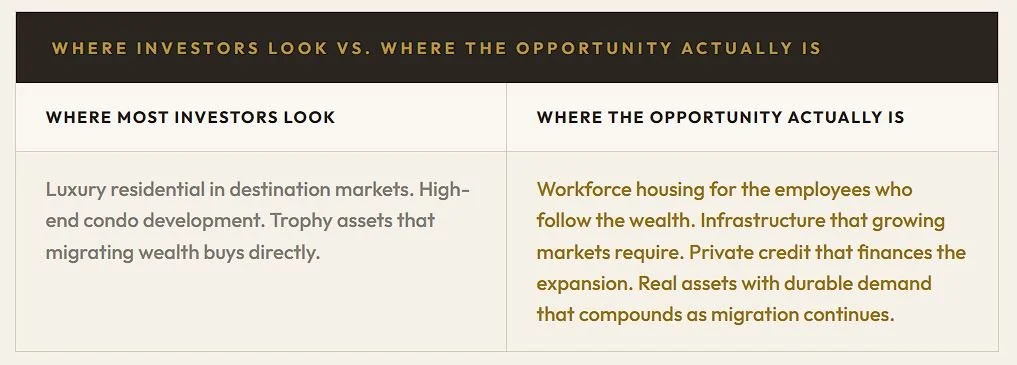
The most important investment opportunities from capital migration are not in the migration itself. They are in the second-order effects: the demand it creates for housing, infrastructure, services, and real assets in the receiving markets.
-
When wealthy individuals relocate, they bring businesses, employees, and service networks. The employees who support those businesses, from healthcare workers to retail staff to construction crews, need housing they can afford. That demand is non discretionary and structural.
-
Growing markets require roads, utilities, schools, hospitals, data centers, and logistics facilities. That infrastructure spending creates multi year capital deployment cycles that operate independently of market sentiment.
-
Business formation in receiving states creates demand for office, industrial, logistics, and retail space. Markets that were secondary five years ago are becoming primary markets for institutional deployment.
-
Rapid growth creates financing demand that traditional banks cannot always meet at the required pace. Private lenders with capital and market knowledge capture the gap between demand and traditional lending capacity.
“The biggest opportunities rarely emerge where capital is leaving. They emerge where capital is arriving, in the demand it creates for housing, infrastructure, and real assets that the receiving markets must build to absorb the growth.”
What We Are Watching at Impact Growth Capital
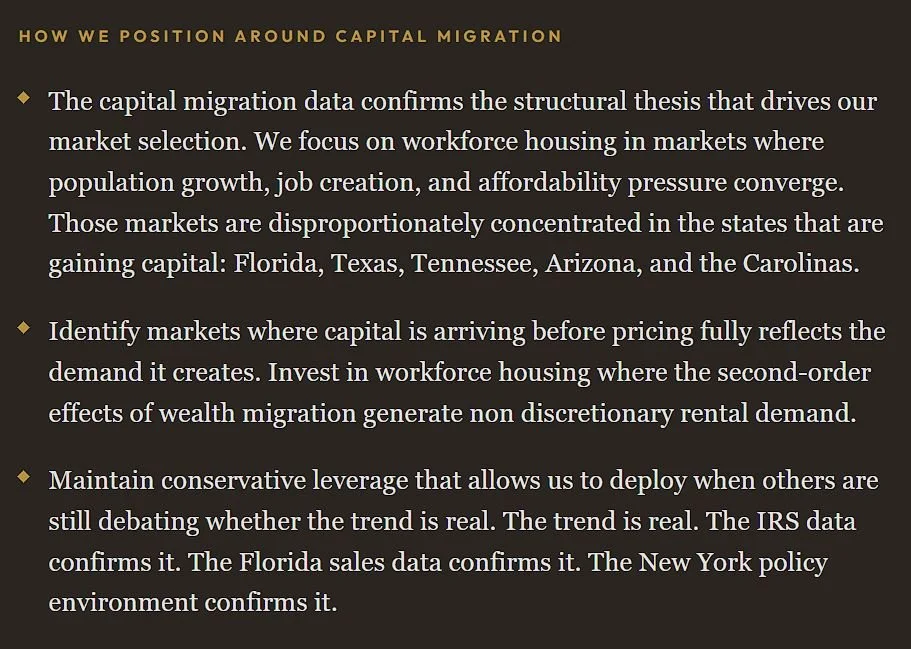
At Impact Growth Capital, we do not invest based on tax policy headlines. We invest based on where capital is flowing and what demand that flow creates for real assets with durable income.
Four Signals from the Capital Migration
New York signed a pied-a-terre tax on second homes valued at $5 million or more, effective July 1. It joins a wave of high tax states adding levies that increase the marginal incentive for mobile capital to relocate.
IRS data shows New York lost $9.9 billion and California lost $11.9 billion in adjusted gross income in a single year. Florida gained $20.6 billion. Capital does not disappear. It moves.
The investment opportunity is not in the migration itself. It is in the second-order effects: workforce housing demand, infrastructure investment, business formation, and private credit opportunities in receiving markets.
The biggest opportunities rarely emerge where capital is leaving. They emerge where capital is arriving, in the demand it creates for housing, infrastructure, and real assets that the receiving markets must build to absorb the growth.
Capital Does Not Have Loyalty. It Has Math.
Capital does not have loyalty. It has math. When the math changes in one jurisdiction, capital recalculates and redeploys. That process is not new. What is new is the scale, the speed, and the cumulative effect of multiple states simultaneously increasing the incentive for wealthy individuals to move.
For allocators, the signal is clear. Follow the capital. Identify the markets where migrating wealth creates demand for workforce housing, infrastructure, and essential services. Position ahead of the pricing. And build portfolios in assets where the demand is structural and the income is observable.
“The biggest opportunities rarely emerge where capital is leaving. They emerge where capital is arriving.”